
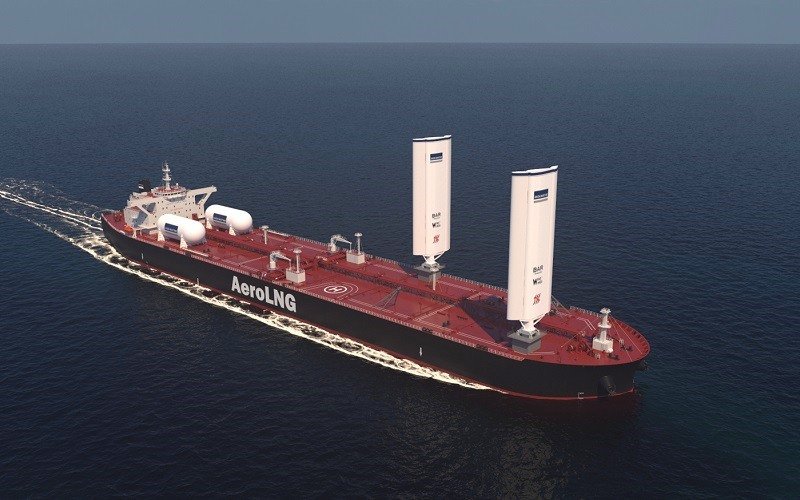
In a landmark move toward integrated clean propulsion, Swiss marine power specialist WinGD has secured its first hybrid integration project for wind-assisted vessels. The company’s advanced X-EL Integrated Energy solution will be deployed across four 113,600 DWT tankers under construction for Union Maritime Limited (UML), combining hybrid power systems with wind-assisted propulsion for enhanced energy efficiency and emissions reduction.
The project marks the first time WinGD’s X-EL system will be used alongside sails, showcasing its capability to harmonize various energy sources—namely, the main engine, wind power, and electric power systems—to deliver optimal vessel performance across all operating conditions.
Table of Contents
Building the Future: Integration of Wind and Hybrid Energy
The tankers will be built by Xiamen Shipbuilding Industry Co., with WinGD providing full hybrid system integration, including:
- Installation of a shaft generator connected to the main engine
- Deployment of WinGD’s X-EL energy management system
- Smart energy distribution between engines, sails, and electrical systems
This integrated energy solution is designed to maximize fuel efficiency by allowing the main engine—traditionally used for propulsion—to also serve as the vessel’s primary power generator via the shaft generator. This approach reduces reliance on auxiliary engines, thereby cutting fuel consumption and emissions even further.
For the first time, WinGD will apply its X-EL solution to third-party main engines, demonstrating the flexibility and scalability of its integrated energy system for a wider vessel market.
A Holistic Approach to Efficiency
Stefan Goranov, Head of Integrated Energy Solutions at WinGD, emphasized the value of real-time, holistic energy management:
“To maximise the energy savings from wind-assisted propulsion, operators need an energy management system that can optimise engine and electrical power in response to the available wind power. UML’s new vessels will be a showcase for the efficiencies that can be achieved through holistic energy management based around the main engine.”
Bhuvnesh Dogra, Head of Technical at UML, added:
“Our ambition is to build the most energy-efficient vessels on the market and we believe wind-assisted propulsion is a key element in achieving that. So too is effective energy management across the vessel. WinGD’s X-EL solution… will be an important contributor to the efficiency of these vessels.”
Proven Technology, Evolving Capabilities
First deployed commercially in 2022, WinGD’s X-EL system uses the power margin of the main engine to generate onboard electricity, rather than relying on less efficient auxiliary engines. This offers:
- Improved fuel economy
- Greater system flexibility
- Real-time optimisation with digital monitoring and control
The system is fully customizable to suit different vessel types, engine manufacturers, and auxiliary energy sources—ranging from batteries and fuel cells to wind-assisted propulsion systems.
About WinGD
WinGD (Winterthur Gas & Diesel Ltd.) is a leading developer of low-speed two-stroke marine engines and integrated energy systems, with a core mission to drive the decarbonisation of global shipping. With a legacy dating back to 1893 as part of Sulzer Diesel, the company is now part of the CSSC Group, and is renowned for its innovations in emissions reduction, hybridisation, and digital energy optimisation. Headquartered in Winterthur, Switzerland, WinGD continues to set global standards in reliability, efficiency, and sustainable marine power solutions.
Source WinGD Ltd.