
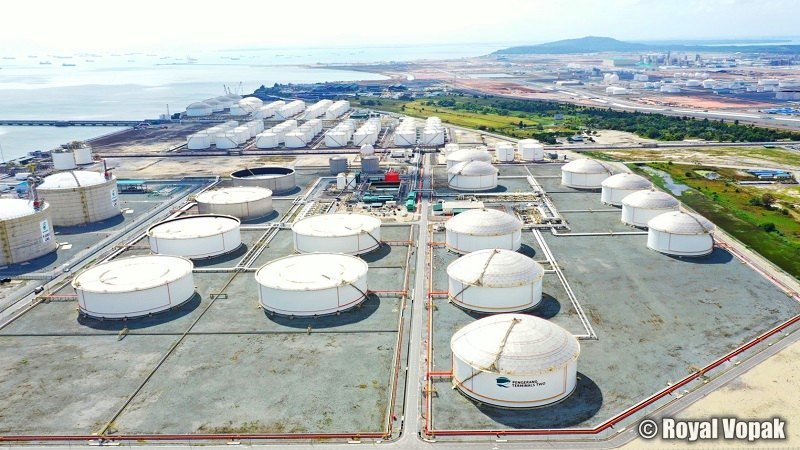
Pengerang, Malaysia – July 31, 2025 – In a powerful affirmation of its ‘accelerate’ strategy towards energy transition infrastructure, Royal Vopak has greenlit a substantial expansion at its Pengerang Terminal (PT2SB) in Malaysia. This strategic investment of 272,000 cubic meters (cbm) in new storage capacity, dedicated to biofuels feedstocks and products, is poised to significantly bolster the supply of critical low-carbon fuels like Hydrogenated Vegetable Oil (HVO) directly into the sphere of influence of the Singapore Straits, a global maritime and bunkering nexus.
This move by Vopak, a company with over 400 years of expertise in independent tank storage, is not merely an isolated capacity addition but a linchpin in a sophisticated regional biofuels ecosystem. The new storage facilities are intrinsically linked to an adjacent, cutting-edge biorefinery, Pengerang Biorefinery Sdn. Bhd. (PBSB). This biorefinery is itself a high-profile joint venture, bringing together PETRONAS Mobility Lestari Sdn. Bhd., Enilive S.p.A. (an entity controlled by Italy’s energy major Eni S.p.A.), and Japan’s Euglena Co., Ltd.
Vopak’s commitment, representing a €72 million share of the biorefinery’s approximately €282 million (USD 330 million) total project investment, is underpinned by a robust 25-year take-or-pay terminal usage agreement with PBSB. This long-term commercial arrangement underscores the confidence of all partners in sustained demand for advanced biofuels and provides Vopak with predictable revenue streams upon commissioning, anticipated by mid-2028.
Table of Contents
Pengerang: A Critical Node for Biofuels Supply and Demand
The Pengerang Integrated Complex (PIC), home to PT2SB, benefits from an unparalleled strategic location at the southeastern tip of Johor. Its position along major international shipping lanes, mere miles from the bustling Singapore oil and bunkering hub, is a deliberate choice. This geographical advantage positions PT2SB as an ideal gateway for the efficient import of diverse, often global, biofuel feedstocks (such as used cooking oil, animal fats, and waste from vegetable oil processing) and the seamless export of finished biofuels.
Vopak’s ethos of enabling the “world flow forward” is increasingly focused on new energy solutions. “This investment perfectly aligns with Vopak’s ‘accelerate’ strategy,” Vopak shared. “It’s about developing the essential infrastructure that supports the energy transition, while simultaneously reinforcing PT2SB’s formidable industrial position within the strategically vital Singapore Straits. We’re actively building out solutions for hydrogen, ammonia, CO2, battery energy storage, and, crucially, low-carbon fuels and feedstocks, paving the way for a more sustainable future across global supply chains.“
The PBSB biorefinery itself is a testament to advanced biofuel production. Designed to process around 650,000 tonnes per year of raw materials, it will leverage proven technologies, including Eni’s proprietary Ecofining™ process. The facility boasts feedstock flexibility and a versatile product configuration, allowing it to maximize the output of SAF, HVO, and bio-naphtha, directly addressing the aviation and transportation sectors’ urgent decarbonization targets.
Bunkering’s Decarbonisation Trajectory: The Pengerang Impact
For the global bunkering industry, particularly those operating in and around the Asia-Pacific’s busiest maritime corridor, this expansion is more than just another project announcement; it’s a profound signal for future fuel availability and infrastructure readiness:
- Scalability for Biofuels Bunkering: The significant scale of 272,000 cbm dedicated storage, coupled with a large-scale biorefinery, indicates a concerted effort to move biofuels from niche offerings to mainstream availability. This is critical for driving down costs and improving supply consistency, which are key barriers to broader adoption for marine propulsion.
- HVO as a Drop-in Solution: The production of HVO (Renewable Diesel) is particularly pertinent for the bunkering sector. As a “drop-in” fuel, HVO can be used directly in existing marine diesel engines without modifications, offering an immediate and effective pathway for shipowners to reduce greenhouse gas emissions. Increased availability near Singapore will facilitate easier adoption.
- SAF Synergies and Future Fuels: While SAF is primarily targeted at aviation, its production within the same complex creates valuable synergies. The underlying processes and feedstock supply chains for SAF and HVO are often intertwined. This could lead to shared logistical efficiencies and potential future flexibility in product output, potentially influencing bunker fuel blending options.
- Strengthening Singapore’s Biofuel Ecosystem: Though located in Malaysia, Pengerang’s close proximity to Singapore strategically enhances the entire regional biofuel ecosystem. It complements Singapore’s own ambitious goals to become a leading green bunkering hub, providing a substantial, secure source of advanced biofuels that can readily feed into the Singapore bunkering market via established transfer mechanisms.
- Long-Term Infrastructure Commitment: The 25-year take-or-pay agreement and Vopak’s broader strategic focus on energy transition infrastructure signify a long-term commitment to these sustainable fuels. This provides a clear investment signal to shipping companies considering newbuilds or retrofits for biofuel compatibility, assuring them of future supply.
- Mitigating Supply Chain Risks: Dedicated, purpose-built storage and direct refinery linkage help to de-risk the biofuel supply chain, ensuring product integrity and efficient distribution, crucial factors for maintaining operational reliability for vessels.
This bold step by Vopak and its partners at the Pengerang Integrated Complex represents a tangible and impactful advancement in the global effort to decarbonize shipping and aviation. By establishing such robust infrastructure at a key strategic nexus, they are not just storing fuel; they are actively shaping the future of sustainable energy flows that are vital for the world’s most critical industries.
About Royal Vopak
Royal Vopak, based in the Netherlands, is the world’s leading independent provider of tank storage infrastructure for energy and chemical products. With a 400-year heritage, Vopak is a key facilitator of the global energy transition, focusing on clean fuel logistics, including ammonia, hydrogen, biofuels, and green methanol. Its China operations play a critical role in supporting regional fuel supply chains through strategically located coastal terminals.
Source Rotal Vopak