
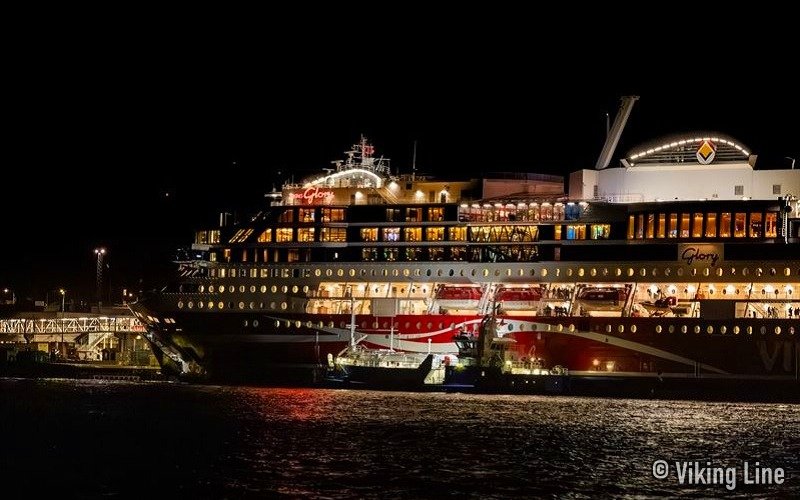
Turku, Finland | February 3, 2026 – While much of the global maritime industry remains anchored in the planning stages of decarbonization, Viking Line has signaled a decisive “full steam ahead.” The Åland-based shipping pioneer has announced it will maintain its massive investment in renewable European biogas (LBG) throughout 2026, securing enough fuel to cover 50% of the requirements for its flagship vessels, Viking Glory and Viking Grace, for the first half of the year.
The move comes on the heels of a transformative 2025, during which Viking Line multiplied its biofuel consumption tenfold. This strategic pivot resulted in a staggering reduction of nearly 50,000 tonnes of greenhouse gas emissions in a single year, a metric that sets a high bar for the Green Shipping Corridor between Turku and Stockholm.
Table of Contents
From Planning to Practice: The Fossil-Free Corridor
The maritime sector is currently flooded with “green corridor” concepts, yet few have achieved the operational scale of the Turku-Stockholm route. In collaboration with the Ports of Stockholm and the Port of Turku, Viking Line is working toward a definitive goal: a completely fossil-free corridor by 2035.
“Globally, there is no lack of initiatives to create fossil-free sea lanes, but most are still in the planning stages,” noted Marcus Risberg, CEO of Viking Line. “Our investment in biogas and energy-efficient vessels is one of the clearest and largest-scale examples of how shipping can transition in practice.”
The reliance on biogas, used in tandem with Liquefied Natural Gas (LNG), virtually eliminates sulfur and particulate emissions while drastically slashing the carbon footprint of every passenger and ton of freight moved across the Baltic.
Sustainability as “Company DNA”
For Viking Line, the push for cleaner fuels is not merely a response to regulatory pressure but a cultural imperative. Headquartered in the environmentally sensitive Åland archipelago, the company views the Baltic Sea’s health as a core business priority.
Marcus Risberg emphasized that even amidst a global climate dominated by security concerns, the transition remains “self-evident.” He stated:
“Sustainability is part of Viking Line’s DNA, I am convinced this direction continues to matter to our passengers, freight customers, employees and partners and, quite simply, to future generations as well.“
2026: A Year of Sustained Ambition
The company’s Head of Sustainability, Dani Lindberg, confirmed that the 50% biogas blend secured for the first half of 2026 is just the baseline. The company’s ambition is to maintain this high-level blend throughout the entire year, depending on market availability and supply chain stability.
“Last year, our greenhouse gas emissions on Glory and Grace were reduced by nearly 50,000 tonnes. For the first half of 2026, we have secured 50 percent biogas to cover our fuel needs, and our ambition is to maintain a high level throughout the entire year,” says Dani Lindberg, Head of Sustainability at Viking Line.
By choosing these specific vessels, Viking Line’s customers are no longer passive travelers; they are active participants in the bunkering market’s shift. Each booking directly influences the volume of biogas injected into the ship’s operations, creating a demand signal that the renewable fuel market desperately needs.
About Viking Line
Viking Line is the leading provider of passenger traffic on the Baltic Sea, with services connecting Sweden, Åland, Finland, and Estonia. The company operates a fleet of vessels including Viking Cinderella, Viking Grace, Viking Glory, Gabriella, and Viking XPRS, serving over 5 million passengers annually. Viking Line is committed to reducing the environmental impact of its operations through innovation and sustainable practices, making it a pioneer in eco-friendly maritime transport.
Source Viking Line