
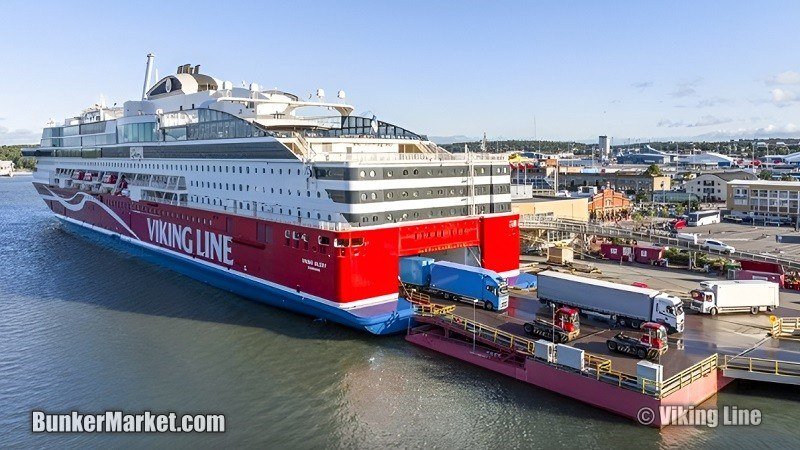
Valio, Finland’s largest dairy producer, has begun transporting its products from Finland to Sweden using fossil-free maritime transport on Viking Line’s biogas-powered vessels, Viking Glory and Viking Grace. This shift marks a significant advancement in the creation of a green shipping corridor between Turku and Stockholm, contributing directly to Valio’s broader goal of achieving a carbon-neutral milk chain by 2035.
Table of Contents
Dairy Delivered with 90% Lower Emissions
Since early May, Valio’s shipments to Sweden are being carried by Viking Glory and Viking Grace, vessels powered by liquefied biogas (LBG) produced from waste. This switch from conventional marine fuels to biogas has enabled a reduction of approximately 90% in greenhouse gas emissions from the maritime segment of the company’s logistics chain.
While fossil-free maritime transport still represents just 0.1% of global shipping, Valio’s adoption of LBG-powered sea transport illustrates that the maritime green transition is not only feasible but actively underway.
Harri Tamminen, Freight Director at Viking Line, emphasized the potential for wider adoption, “Fossil-free maritime transport is still rare globally. But as we demonstrate with Valio’s logistics, the transition is possible today. We hope more cargo clients will choose biogas-powered shipping, which can deliver immediate and significant climate benefits.”
Fossil-Free Transport from Origin to Destination
The full transport chain for Valio’s products—from collection at production sites in Finland to delivery in Sweden—is now entirely fossil-free, incorporating low-emissions trucking on land and biogas-powered ferry transport across the Baltic.
Anette Björnlund, Sustainability Manager at Valio Sweden, highlighted the move as a key milestone in the company’s climate roadmap, “We’ve made continuous efforts to reduce emissions across our value chain. Now, we can proudly say that our logistics—by truck and by ship—are fully fossil-free. This is a vital step toward our vision of a carbon-neutral milk chain by 2035.”
Valio’s shift to biogas marine transport not only enhances its sustainability credentials but sets a high benchmark for supply chain decarbonisation in the food industry.
A Green Shipping Corridor by 2035
The Turku–Stockholm corridor is central to ongoing regional efforts to establish one of the world’s first green shipping lanes, with a full transition targeted for 2035. Key stakeholders in the initiative include Viking Line, Ports of Turku and Stockholm, and now leading cargo shippers such as Valio and Orkla ASA—the Norwegian conglomerate known for brands like Felix, which also recently switched to biogas shipping on Viking Line vessels.
The route is particularly significant as 90% of cargo between Finland and Sweden is transported by sea, making maritime decarbonisation a critical focus for sustainable trade in the region.
Biofuel Options Extend to Passengers
Viking Line is also expanding its biofuel offering beyond cargo. Passengers and conference customers now have the option to purchase biogas equivalent to the fuel used during their journey, thereby reducing their carbon footprint by up to 90%. This initiative helps to democratise green travel by offering climate-conscious choices to individual travelers.
About Valio: Science-Driven, Farmer-Owned, Export-Focused
Founded over a century ago and owned by 4,000 Finnish dairy farmers, Valio is a global innovator in dairy and food production. The company combines scientific research, animal welfare, and sustainable practices to create high-quality products sold in over 60 countries. With more than 350 international patents and a legacy tied to Nobel Laureate A.I. Virtanen, Valio leads Finland’s food export sector and is a vocal advocate for environmental responsibility in the industry.
In 2021, Valio reported €1.918 billion in sales, underscoring its position as a powerhouse in both the domestic and international food markets.
About Viking Line
Viking Line is the leading provider of passenger traffic on the Baltic Sea, with services connecting Sweden, Åland, Finland, and Estonia. The company operates a fleet of vessels including Viking Cinderella, Viking Grace, Viking Glory, Gabriella, and Viking XPRS, serving over 5 million passengers annually. Viking Line is committed to reducing the environmental impact of its operations through innovation and sustainable practices, making it a pioneer in eco-friendly maritime transport.
Source Viking Line