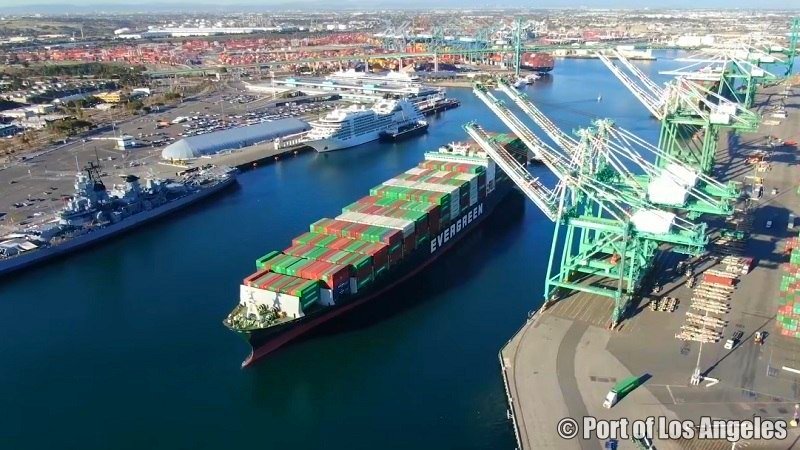
Los Angeles & Long Beach, USA | September 24, 2025 — In what could mark a turning point for U.S. shipping and port operations, the Ports of Los Angeles and Long Beach have formally issued a Request for Information (RFI) for a groundbreaking methanol bunkering pilot project. Developed in partnership with C40 Cities Climate Leadership Group, the initiative signals the most ambitious move yet by a U.S. port complex to prepare for the large-scale use of low- and zero-carbon marine fuels.
The San Pedro Bay Ports (SPBP), together the nation’s largest container gateway and one of California’s most emissions-intensive industrial hubs, aim to establish a model for safe, regulated, and scalable methanol bunkering operations. This is not just a pilot; it is a blueprint for decarbonizing American ports.
Table of Contents
Methanol: From Emerging Alternative to Mainstream Marine Fuel
The RFI situates methanol within the global decarbonization race. Methanol (CH₃OH) is a simple liquid alcohol that remains stable at ambient temperatures, contains no sulfur, and significantly cuts nitrogen oxides, particulate matter, and greenhouse gas emissions compared to heavy fuel oil. Its full environmental potential, however, depends on how it’s produced.
When derived from renewable sources — bio-methanol or e-methanol — it can achieve near-zero lifecycle emissions, making it a powerful tool for meeting the International Maritime Organization’s (IMO) greenhouse gas targets.
Ports such as Rotterdam, Singapore, and Shanghai have already proven methanol bunkering operations feasible. Demand is rising fast: over 300 methanol-ready vessels are currently on order worldwide, and global supply of green and low-carbon methanol is forecast to exceed 50 million tons annually by 2030.
By embracing methanol now, SPBP is positioning itself alongside the world’s most forward-looking maritime hubs.
A Pilot with Clear Objectives
According to the RFI, the pilot project has six core goals:
- Demonstrate Operational Feasibility: Show that methanol bunkering can be conducted safely, efficiently, and reliably at the scale of a major U.S. port.
- Clarify Regulatory Pathways: Work closely with the U.S. Coast Guard, local fire departments, and permitting authorities to streamline compliance, reduce uncertainty, and develop best-practice frameworks for methanol fueling.
- Generate Data and Insights: Collect, measure, and report operational data — emissions profiles, safety metrics, logistics, and crew training outcomes — to inform future standards and national guidelines.
- Support Market Readiness: Provide confidence to shipowners, fuel suppliers, and infrastructure providers that methanol will be available and operable at SPBP, unlocking investment in methanol-capable vessels and delivery systems.
- Reduce Early-Adopter Risks: Explore public–private partnerships (PPPs) and other mechanisms to share risks among suppliers, ports, and regulators — a critical step for enabling early-stage adoption.
- Accelerate California’s Leadership: Align the pilot with California’s aggressive decarbonization targets and international shipping climate commitments, positioning SPBP as a national model for clean fuel adoption.
A Wide Net: Industry Invited to Shape the Pilot
The RFI is not a passive exercise. It actively seeks detailed input from a broad array of stakeholders:
- Vessel Owners and Operators: Which ships could call at LA/LB for methanol bunkering? What are the frequency and volume requirements? What bunkering methods — truck-to-ship, barge-to-ship, or shore-to-ship — are most suitable?
- Fuel Suppliers: What volumes and types of methanol (bio-, e-methanol, or blends) can be supplied? What is the carbon intensity of that supply, and is it certified under ISCC or RSB standards?
- Terminal Operators and Bunkering Service Providers: What storage, transfer, and bunkering infrastructure is already in place? What upgrades — retrofits or new builds — would be needed, and on what timelines?
- Regulatory Authorities: What gaps and challenges exist in permitting methanol operations? What lessons have been learned from other ports?
This comprehensive questioning spans 10 focus areas, including vessel demand, supply logistics, safety and permitting, infrastructure readiness, bunkering methods, commercial models, partnerships, data and digitalization, training, and barriers to scaling up.
A Highly Structured Inquiry
The RFI drills down into specifics rarely seen in such calls. For example:
- Simultaneous Operations (SIMOPS): Can bunkering be performed during cargo handling? Under what conditions?
- Safety Protocols: What spill prevention, containment, and recovery systems will be in place?
- Commercial Frameworks: Would suppliers prefer index-based pricing, cost-plus, or fixed pricing mechanisms? How should liability and insurance be allocated?
- Governance Models: Should offtake agreements be bilateral, or aggregated across shipping lines to build demand? Would a transparent marketplace or registry help align supply and demand?
The Ports are effectively saying: “Help us design not just the pilot, but the market.”
Deadline and Submission Details
- Response Deadline: October 22, 2025 at 23:59 Pacific Time (extensions possible)
- Submission Format: PDF
- Submission Emails: ports@c40.org
Respondents should identify primary contacts and can submit individually or as part of a consortium.
Why This Matters: Setting the Benchmark for U.S. Methanol Bunkering
This initiative isn’t just about one pilot. It’s about de-risking the future of methanol in the U.S. maritime sector:
- It could establish the first large-scale methanol bunkering operation on American soil.
- It sends a clear market signal that methanol infrastructure investment is viable.
- It offers a template for federal, state, and local regulators to harmonize safety, permitting, and emissions reporting requirements.
For fuel suppliers, shipowners, and port operators, this is a unique opportunity to shape the future of clean marine fuel infrastructure rather than reacting to it.
A Defining Moment for U.S. Shipping’s Green Future
As international regulations tighten and zero-carbon corridors emerge, ports that act now will set the standards others follow. The San Pedro Bay Ports’ methanol bunkering pilot represents not just compliance with California’s climate ambitions but a chance to lead a national transformation in maritime energy.
If successful, the pilot could do for methanol in the U.S. what Singapore and Rotterdam have already done globally: turn a promising fuel into a mainstream reality.
Read the full RFI document here: Methanol Bunkering at SPBP
San Pedro Bay Ports
The San Pedro Bay Ports refer to the combined port complex of the Port of Los Angeles and the Port of Long Beach, located in Southern California. Together, they form the largest container port complex in the United States and one of the busiest in the world. Sharing the San Pedro Bay coastline, these two ports handle over 30% of all U.S. containerized imports, playing a central role in global trade, logistics, and increasingly, the transition to cleaner maritime fuels.
About C40 Cities
C40 Cities Climate Leadership Group is a global coalition of nearly 100 of the world’s most influential cities, working together to confront the climate crisis through ambitious, science-based action. Founded in 2005, C40 operates on the principle that cities are uniquely positioned to lead climate solutions, given their control over key sectors such as transportation, buildings, energy use, and waste management.
C40 supports mayors and local governments in cutting emissions, building resilience, and improving public health and equity. Its strategic focus includes halving emissions by 2030, transitioning cities off fossil fuels, and ensuring climate justice is embedded in all policy development.
What sets C40 apart is its data-driven approach, peer-to-peer collaboration among cities, and its connection to multilateral policy influence. The group is governed by a Steering Committee of mayors and supported by a team of experts in urban planning, energy, transportation, and finance.
Notably, C40 has played a major role in championing green shipping corridors, sustainable port development, and zero-emission freight solutions — especially in coastal and port cities.
The network is backed by philanthropic and institutional partners, including Bloomberg Philanthropies, Children’s Investment Fund Foundation, and Realdania. It is currently co-chaired by Mayor Sadiq Khan of London and Mayor Yvonne Aki-Sawyerr of Freetown, with Michael R. Bloomberg serving as President of the Board.
About the Port of Long Beach
The Port of Long Beach is one of the most advanced and environmentally progressive seaports in the world. As the second-busiest container port in the United States, it plays a pivotal role in U.S. supply chains, handling over 8 million TEUs annually and facilitating $200 billion worth of trade.
Renowned for its efficiency and innovation, the Port has earned global accolades including “Best West Coast Seaport” for six consecutive years. It is a preferred gateway for trans-Pacific trade and a leader in digital freight systems and sustainable logistics.
The Port of Long Beach has long set the bar for green port initiatives, being among the first to implement shore power systems, clean truck programs, and terminal electrification. It co-developed the Clean Air Action Plan with the Port of Los Angeles, and continues to lead in advancing alternative marine fuels and zero-emission technologies.
About the Port of Los Angeles
The Port of Los Angeles, often referred to as “America’s Port,” is the busiest container port in North America, playing a critical role in trans-Pacific trade and the U.S. economy. Located in San Pedro Bay, California, the port has maintained its top national ranking for 24 consecutive years and is a vital logistics hub for everything from consumer electronics to raw materials.
In 2023, the Port handled 8.6 million twenty-foot equivalent units (TEUs) and generated $292 billion in cargo value, supporting one in nine jobs across Southern California. Its logistics and supply chain infrastructure are interconnected with over 100 international shipping lines and thousands of inland distribution points via rail and truck.
The Port is not only a trade engine but also an environmental leader. It pioneered the Clean Air Action Plan (CAAP) — a globally recognized blueprint to cut port-related emissions through clean technologies, electrification, and alternative fuels. It is also a founding partner of the Pacific Green Shipping Corridor, an initiative aimed at decarbonizing shipping routes between key global ports.
With a focus on sustainability, workforce development, digitalization, and community engagement, the Port of Los Angeles continues to be a bellwether for innovation in the maritime industry
Source Port of Los Angeles