
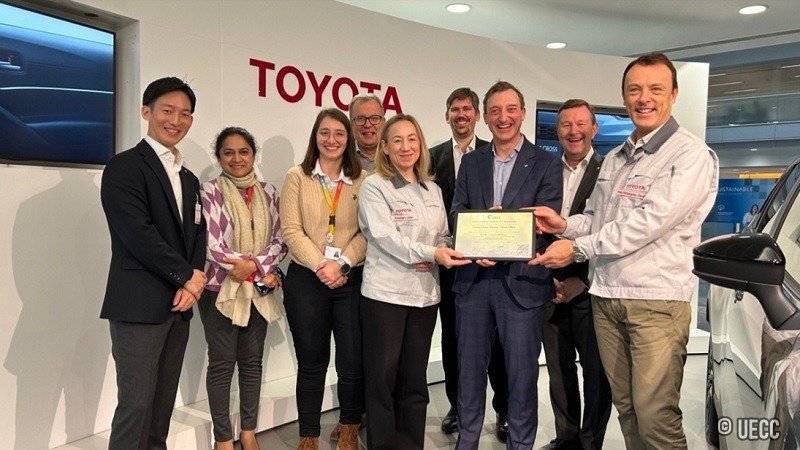
Oslo, Norway | January 13, 2026 – United European Car Carriers (UECC) has achieved a major decarbonization breakthrough with its pioneering “Sail for Change” program, enabling Toyota Motor Europe (TME) to slash its Scope 3 emissions by 22,148 tonnes of CO2e in just five months. This reduction marks one of the most significant tangible gains in sustainable finished vehicle logistics to date, proving the immediate impact of UECC’s strategic shift to low-carbon bunkering.
The savings, equivalent to the climate impact of growing more than 366,000 tree seedlings over a decade, were realized between August and December 2024. During this period, UECC transported 54,991 Toyota vehicles using a strategic blend of sustainable biofuels and liquefied biomethane (bioLNG).
Table of Contents
Data-Driven Decarbonization
The figures are more than just internal estimates. Independent third-party verifier EnviroSense has validated the emissions savings as compliant with the EU’s RED II sustainability criteria. This rigorous certification covers the entire lifecycle of the fuel, from agricultural biomass and bio-waste feedstock to the point of combustion, providing TME with high-fidelity data for its ESG reporting.
At a recent ceremony at Toyota’s European headquarters in Brussels, UECC’s Chief Operating Officer Per Christian Mørk presented the certificate of verification to TME’s leadership team, including Jean Christophe Deville, VP Supply Chain, and Rosemary Lister, Head of Raw Material, Indirect and Logistics Purchasing.
2025: Doubling Down on Green Shipping
The partnership is set to accelerate. UECC disclosed that TME is on track to more than double its impact in 2025, with a target reduction of 57,448 tonnes of CO2e.
This surge will be driven by:
- Expanded Routes: Shipments from Toyota plants in Turkey and the Czech Republic to Northern European hubs.
- Increased Volume: UECC now handles nearly 200,000 Toyota vehicles annually.
- Alternative Fuel Bunkering: Heavy reliance on bioLNG (LBM) and B100 biofuels across UECC’s fleet of Pure Car and Truck Carriers (PCTCs).
“These are not merely numbers; they represent a shared vision and a joint responsibility to create a cleaner, more sustainable future for our industry and our planet,” stated UECC’s Chief Operating Officer Per Christian Mørk.
Setting a New Standard for Logistics Decarbonization
The partnership is a central pillar of TME’s broader mission to eliminate carbon from its entire supply chain. By integrating UECC’s low-carbon solutions, Toyota is moving beyond theoretical targets into measurable, verified action.
“The significant emissions reduction achieved in 2024 represents a big step forward in our efforts to reduce the carbon footprint of our logistics and underpins the value of our partnership with UECC in realizing common sustainability goals,” said Jean Christophe Deville, TME’s Vice President Supply Chain.
Toyota’s commitment is also tied to its role in Drive Sustainability, a collective of 11 leading automotive manufacturers working to establish uniform compliance criteria for carbon-neutral supply chains. Deville emphasized that UECC’s ability to provide high-transparency, low-carbon solutions is exactly what the industry’s new standards demand.
“We are dependent on business partners with a shared sense of environmental responsibility,” Deville added. “The ability of logistics providers to offer low-carbon solutions is at the core of our Sustainable Purchasing Guidelines. UECC has shown the way by driving forward sustainable short-sea RoRo shipping in Europe.”
Strategic Innovation: Investing in the Next Fleet Generation
“Our long-standing partnership with TME supports our low-carbon investments in technologies that deliver both commercial and environmental rewards,” UECC CEO Glenn Edvardsen stated. “We are expanding our fleet and pushing forward new initiatives, including exploring next-generation fuel options, that help reduce emissions, support the demand for sustainable operations, and progress toward net zero.”
Glenn Edvardsen emphasized that these partnerships provide the commercial foundation for long-term investment in green technology. The company is currently:
- Expanding the Fleet: Integrating new multi-fuel LNG battery hybrid PCTCs.
- Exploring New Horizons: Researching synthetic fuels (e-fuels) and ammonia-ready designs.
- Regulatory Advantage: Leveraging a “compliance surplus” under FuelEU Maritime to insulate customers from carbon pricing and penalties.
As the maritime industry faces tightening pressure from the EU ETS and IMO regulations, the UECC-Toyota collaboration serves as a “masterclass” in how carriers and cargo owners can turn environmental mandates into a competitive edge.
About UECC
United European Car Carriers (UECC) is a leading provider of sustainable shortsea transportation services for cars and other rolling cargo in Europe. With a focus on innovation and sustainability, the company operates a fleet of eco-friendly vessels, including dual-fuel LNG and hybrid battery-powered PCTCs. UECC is committed to achieving net-zero emissions by 2040 while advancing sustainable practices in the shipping industry. UECC’s headquarters are based in Oslo, Norway, with subsidiary companies and branch offices around Europe.
Source United European Car Carriers