
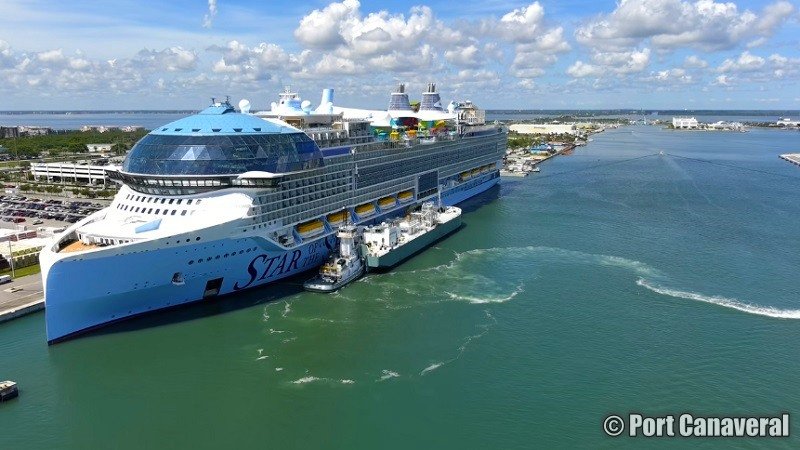
Landmark Operation Positions Port Canaveral as a Sustainable Cruise Fueling Hub, Showcases Seaside LNG’s Integrated Marine Fuel Supply Chain
PORT CANAVERAL – August 14, 2025 — In a historic milestone for Florida’s Space Coast and the broader maritime industry, Port Canaveral has hosted the first-ever LNG bunkering of Royal Caribbean International’s newest and world’s largest cruise ship, Star of the Seas. The fueling operation, conducted on August 14, was completed by Seaside LNG using the Jones Act-compliant bunker barge Clean Everglades, and supported by JAX LNG and Pivotal LNG.
This landmark event marks a critical step forward for:
- Port Canaveral’s clean fuel infrastructure readiness
- Royal Caribbean’s LNG cruise fleet expansion
- Seaside LNG’s integrated marine fueling capabilities
Together, the operation reflects the maturing LNG ecosystem now enabling large-scale decarbonization in cruise shipping.
Table of Contents
Operation Overview: Seven Hours of Precision and Partnership
The LNG bunkering of Star of the Seas took place over a seven-hour fueling window, in which Seaside LNG’s Clean Everglades delivered cryogenic LNG to the vessel while docked at Port Canaveral.
The operation involved:
- High-volume cryogenic LNG transfer from Clean Everglades
- Real-time safety monitoring by Canaveral Fire Rescue’s Fireboat2
- Oversight from Brevard County Sheriff’s Marine Unit and the U.S. Coast Guard
- Full compliance with all LNG handling regulations, environmental standards, and port safety protocols
This bunkering is not only a technical and logistical achievement — it reflects the growing maturity of LNG infrastructure at U.S. cruise ports, and underscores Port Canaveral’s emergence as a key LNG fueling hub for the cruise sector.
Port Canaveral: A Clean Fueling Hub for the Future of Cruising
Already one of the world’s busiest cruise ports, Port Canaveral is now also a frontrunner in alternative fuel adoption for cruise operations. This first LNG cruise fueling reflects the port’s:
- Investment in LNG readiness and terminal infrastructure
- Development of safety procedures and emergency coordination protocols
- Strategic alignment with cruise lines advancing low-emission fleets
As more LNG-powered ships join the global fleet, Port Canaveral is positioned to be a leading LNG bunkering gateway for the U.S. Southeast and beyond.
Star of the Seas: Flagship of Royal Caribbean’s Destination Net Zero Strategy
The Icon-class Star of the Seas is the newest addition to Royal Caribbean International’s fleet and the largest cruise ship in the world. She represents the next chapter in sustainable cruising through:
- Full LNG propulsion
- Advanced energy efficiency systems
- Alignment with Royal Caribbean’s Destination Net Zero roadmap
Environmental benefits of LNG fuel include:
- 100% elimination of sulfur oxide (SOₓ) emissions
- Up to 85% reduction in nitrogen oxides (NOₓ)
- Up to 95% reduction in particulate matter
- Up to 20% lower CO₂ emissions versus conventional fuels
After bunkering, Star of the Seas will embark on her maiden voyage from Port Canaveral on August 16, followed by weekly 7-night sailings to The Bahamas and the Caribbean beginning August 31.
Seaside LNG: Delivering the Fuel Behind the Transition
As North America’s only fully integrated LNG marine fuel platform, Seaside LNG offers:
- Shoreside liquefaction (via JAX LNG)
- Cryogenic LNG storage
- A fleet of Jones Act-compliant LNG bunker vessels
The Clean Everglades, supported by Tug Tortuga, was deployed for this bunkering. With a capacity of 5,500 cbm, the barge was delivered in late 2023 and now services LNG customers along the Southern Atlantic and Gulf Coast regions.
Seaside LNG has now completed:
- Over 665 LNG bunkering operations
- 250 million gallons of LNG delivered
Seaside LNG fleet includes:
| Vessel | Operating Area | Capacity | In Operation |
|---|---|---|---|
| Clean Canaveral & Tug Polaris | Southern Atlantic | 5,500 cbm | 2022 |
| Clean Jacksonville | Southern Atlantic – Gulf Coast | 2,200 cbm | 2018 |
| Clean Everglades & Tug Tortuga | Southern Atlantic – Gulf Coast | 5,500 cbm | 2023 |
These figures reflect the company’s ongoing leadership in clean fuel supply chain execution.
JAX LNG: Infrastructure Enabling the Energy Transition
The LNG used in this operation originated from JAX LNG, a joint venture between Seaside LNG and Pivotal LNG. The facility is:
- The first small-scale shoreside LNG terminal in the U.S.
- Capable of producing 360,000 gallons per day
- Equipped to store up to 4 million gallons of LNG
- Designed to serve both marine and overland markets
JAX LNG plays a central role in enabling consistent fuel supply to cruise ships operating out of Port Canaveral, Jacksonville, and the broader region.
Safety and Standards: At the Core of LNG Bunkering
Safety remains paramount across all Seaside LNG operations. The bunkering of Star of the Seas was conducted under:
- Rigorous third-party audits
- Use of remote shutoff systems and cryogenic transfer tech
- Comprehensive fire safety protocols
- Highly trained crews meeting and exceeding international LNG handling standards
By applying best-in-class engineering and risk mitigation practices, Seaside LNG ensures each operation is not only compliant — but a model for the industry.
Royal Caribbean’s LNG Commitment with Star of the Seas
Star of the Seas represents the next generation of sustainable cruise travel. As Royal Caribbean’s newest Icon-class vessel and the largest cruise ship in the world, she is fully powered by LNG — reducing her carbon intensity and aligning with the company’s Destination Net Zero strategy. The ship’s propulsion system reflects an investment not just in fuel, but in the broader ecosystem of emissions reduction technologies, including:
- LNG-compatible hybrid engine systems
- Shore power capabilities
- Waste heat recovery systems
- Advanced air lubrication and hull efficiency technologies
With LNG fueling now successfully completed at Port Canaveral, Star of the Seas is set to begin week-long itineraries to the Caribbean and The Bahamas starting August 31, ushering in a new era of climate-conscious cruising.
LNG as a Transition Fuel: Meeting Today’s Targets, Enabling Tomorrow’s Fuels
As decarbonization pressure builds through:
- The IMO Revised GHG Strategy
- The EU FuelEU Maritime Regulation
- Increasing market and ESG expectations
LNG is gaining momentum as a credible and scalable maritime transition fuel.
It enables:
- Immediate reductions in GHG and air pollutants
- Infrastructure compatibility with future fuels (e.g., bio-LNG, e-methane)
- Operational readiness without waiting for next-gen technologies
For cruise lines, ports, and fuel suppliers, the successful fueling of Star of the Seas is not a symbolic win — it’s a working example of real, measurable progress.
About Royal Caribbean
Royal Caribbean International is a global cruise leader known for innovation at sea. With a fleet of award-winning ships — including the world’s largest and most advanced — the brand delivers unforgettable vacations to over 240 destinations worldwide.
Royal Caribbean is a pioneer in sustainable cruising, leading the industry with investments in LNG propulsion, shore power, and its Destination Net Zero strategy to achieve net-zero emissions by 2050.
About Seaside LNG
Seaside LNG delivers integrated LNG production, storage, and bunkering through a fleet of Jones Act-compliant bunker vessels and ownership of the JAX LNG terminal. With over 250 million gallons delivered and 665 operations completed, Seaside LNG is enabling safe, scalable LNG fueling for the marine energy transition.
About Port Canaveral
One of the world’s busiest cruise ports, Port Canaveral is a leading maritime gateway on Florida’s Space Coast. Home to Royal Caribbean’s largest vessels, the port is actively advancing its clean fuel capabilities, terminal infrastructure, and emergency readiness to lead the next era of sustainable cruise logistics.
Source Port Canaveral | Seaside LNG