
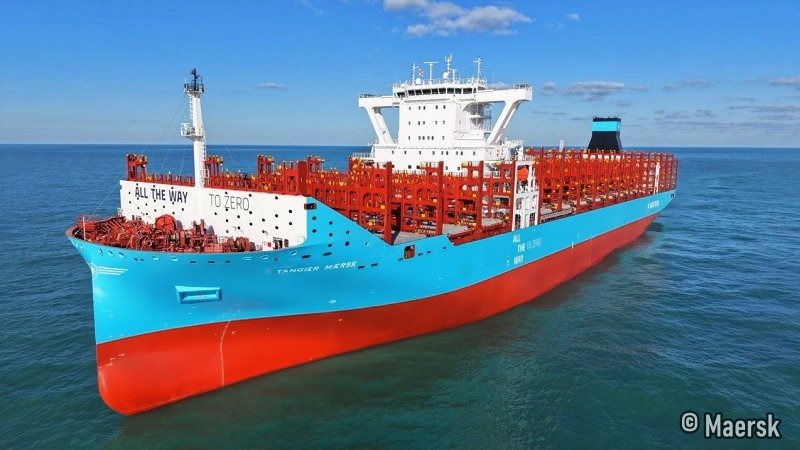
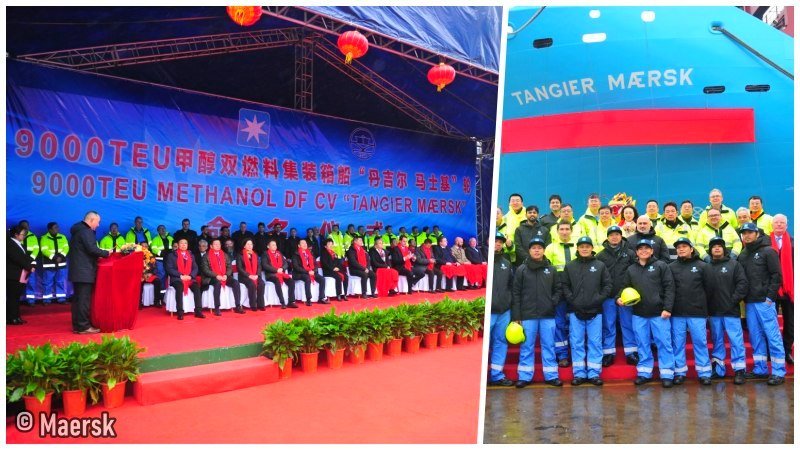
Copenhagen, Denmark | February 2, 2026 – A.P. Moller – Maersk has officially taken delivery of the Tangier Mærsk, the lead vessel in a new series of six mid-sized container vessels designed to bridge the gap between regional feeders and ultra-large ocean carriers.
Delivered three months ahead of schedule by the Yangzijiang Shipbuilding Group, the 9,000 TEU vessel represents a critical phase in Maersk’s “Green Methanol” roadmap. Unlike the 16,000+ TEU “Equinox” class designed for major Asia-Europe loops, this new mid-size class offers the operational flexibility to navigate the Panama Canal and serve diverse global trade lanes.
Table of Contents
Strategic Deployment: The TP15 Service
On its maiden voyage, the Tangier Mærsk will call at Shanghai before joining Maersk’s TP15 service. This strategic route connects East Asia to the US Gulf Coast, passing through the Panama Canal, a transit that necessitates the precise 9,000 TEU dimensions of this new class.
According to Anda Cristescu, Head of Chartering & Newbuilding at Maersk, the delivery is a cornerstone for the carrier’s long-term competitiveness:
“Together with the remaining vessels in the series, it will contribute to our ongoing fleet renewal and support our long-term competitiveness.”
Bunkering & Technical Specifications
The Tangier Mærsk is equipped with a dual-fuel engine capable of running on green methanol. This technical choice is a significant move for the bunkering industry, as these mid-sized vessels will require more frequent, distributed refueling stops compared to their larger counterparts.
| Feature | Specification |
| Capacity | 9,000 TEU |
| Engine Type | Dual-Fuel (Methanol / Conventional) |
| Shipyard | Yangzijiang Shipbuilding Group |
| Estimated CO2 Savings | 450,000 tons annually (for the full series on green methanol) |
Maersk defines “reduced GHG emissions fuels” as those achieving at least a 65% reduction in lifecycle emissions compared to standard fossils (94 g CO2e/MJ). By utilizing bio-methanol or e-methanol, Maersk aims to edge closer to its ambitious 2040 net-zero target.
Future Outlook
The rollout of this series is expected to accelerate throughout 2026.
- Late 2026: Four additional sister vessels are slated for delivery.
- Early 2027: The sixth and final vessel of the series will join the fleet.
The arrival of the Tangier Mærsk brings Maersk’s operational methanol-enabled fleet to approximately 20 vessels, signaling a maturing market for alternative marine fuels even as the company explores secondary pathways like LNG-dual fuel orders to ensure fleet resiliency.
About A.P. Moller – Maersk
A.P. Moller – Maersk is a global leader in integrated logistics, committed to connecting and simplifying its customers’ supply chains. With operations in over 130 countries and a workforce of around 100,000 employees, Maersk is at the forefront of shipping, terminal operations, and logistics solutions.
The company is driving the transition to sustainable shipping, aiming to achieve net-zero GHG emissions by 2040 through investments in alternative fuels, energy-efficient vessels, and digital innovation with at least 65% lifecycle emissions reductions, and extensive efficiency measures such as this retrofit programme. Maersk is dedicated to shaping the future of global trade with end-to-end supply chain solutions that enhance efficiency, reduce costs, and promote environmental sustainability.
Source: Maersk