
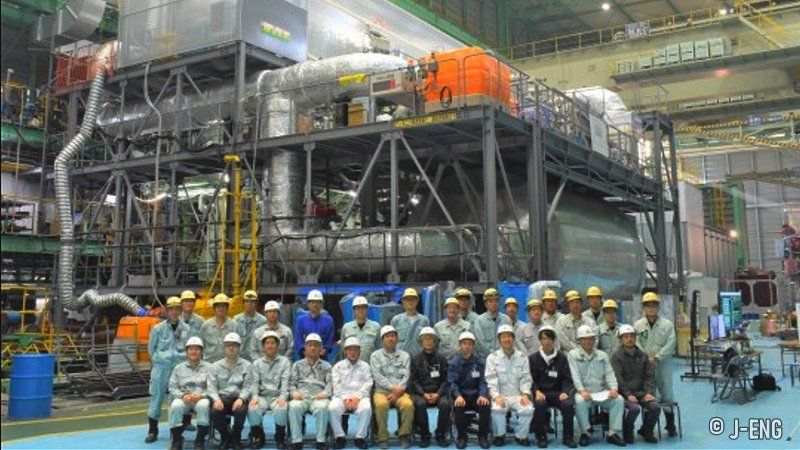
Japan Engine Corporation completes the world’s first full-scale commercial ammonia-fueled marine engine, setting a new benchmark for zero-emission propulsion.
Akashi, Japan | September 1, 2025 – The maritime industry’s pursuit of zero-emission propulsion reached a historic inflection point in August as Japan Engine Corporation (J-ENG) announced the successful completion of the world’s first full-scale commercial ammonia-fueled marine engine.
The engine, model 7UEC50LSJA-HPSCR, completed its final official performance trials between August 27 and 30, 2025, marking the first time a commercially rated, deep-sea engine has demonstrated sustained operation on ammonia fuel. Unlike experimental prototypes, this is a 50-centimeter bore, seven-cylinder low-speed engine designed for real-world commercial service.
Table of Contents
Engineering Ammonia: From Theory to Reality
Ammonia has long been viewed as the maritime sector’s “holy grail” fuel, carbon-free at combustion but plagued by ignition challenges, toxicity concerns, and secondary greenhouse gas risks. Data released by J-ENG following 100% load trials indicate that these barriers have now been decisively addressed.
Key performance outcomes include:
- Greenhouse Gas Reduction: More than 90% reduction in total GHG emissions versus conventional fuel operation
- N₂O Mitigation: At a 95% ammonia co-firing rate, nitrous oxide emissions were limited to approximately 3 ppm, neutralizing a major climate concern
- Ammonia Slip: Post-SCR monitoring confirmed virtually zero unburned ammonia emissions
- Efficiency: Thermal efficiency in ammonia mode matched, or exceeded, that of heavy fuel oil (HFO)
“This achievement reflects years of meticulous engineering and validation,” J-ENG stated. “We have moved beyond laboratory development and into real social implementation.”
From Factory Floor to Open Sea
The engine’s journey is already underway. Shipment is scheduled for October 2025 to JMU Ariake Shipyard, where it will be installed aboard an Ammonia-Fueled Medium Gas Carrier (AFMGC).
Subject to successful sea trials, the vessel is expected to enter commercial service in 2026, becoming the first ship in history powered by a dedicated commercial ammonia engine.
The project is a flagship initiative under Japan’s Green Innovation Fund, administered by NEDO, underscoring the nation’s strategic intent to lead global decarbonization in maritime transport.
Scaling the Platform: Larger Engines and New Capacity
J-ENG confirmed that development is already underway on a 60-centimeter bore ammonia engine, extending the technology to larger vessel classes.
To meet anticipated global demand, the company is also constructing a new production facility funded by GX (Green Transformation) Economic Transition Bonds. Designed specifically for the complex assembly requirements of dual-fuel ammonia engines, the facility is scheduled to commence operations in fiscal year 2028.
A Defining First-Mover Advantage
With certification secured from ClassNK and strategic backing from major Japanese shipowners and builders, including NYK Line and Nihon Shipyard, J-ENG has effectively set the benchmark for ammonia propulsion.
For global bunkering hubs from Singapore to Rotterdam, the implications are clear: engine technology is no longer the limiting factor. The ammonia fuel supply chain must now accelerate to keep pace with the engine room.
Japan Engine Corporation: Architect of Zero-Emission Propulsion
Headquartered in Akashi, Japan, Japan Engine Corporation has emerged as a cornerstone of the global marine propulsion industry. Formed in 2017 through the consolidation of Kobe Diesel and Mitsubishi Heavy Industries’ marine engine division, J-ENG is the only manufacturer with an integrated system for the UE low-speed engine, one of the three dominant platforms worldwide.
By late 2025, J-ENG has evolved beyond traditional engine manufacturing to become a central architect of shipping’s transition to carbon-neutral fuels.
The UE Engine Legacy
Japan’s domestically developed UE engine series has long rivaled global leaders such as MAN and WinGD. Known for high thermal efficiency and compact design, the platform has progressed through several defining generations:
- LSH Series: Optimized for maximum fuel economy using conventional fuels
- LSJ Series: Incorporating proprietary stratified water injection for enhanced efficiency on MGO
- LSJA Series: The world’s first commercial-grade ammonia-fueled low-speed engines
2025: A Year of Breakthroughs
Three milestones in 2025 have redefined J-ENG’s market position:
- Ammonia Propulsion: Completion of the 7UEC50LSJA-HPSCR, setting a new global benchmark for low-carbon gas carriers
- Hydrogen Advancement: World-first land-based operation of a marine hydrogen engine at the Akashi factory, in partnership with Kawasaki Heavy Industries and Yanmar
- Methanol Expansion: Launch of the UEC50LSJM methanol engine program, targeting completion in 2027
Corporate Strength and Future Outlook
J-ENG operates with a highly specialized workforce of approximately 400 professionals, supported by a blue-chip shareholder base including:
- Mitsubishi Heavy Industries, Ltd.
- Namura Shipbuilding Co., Ltd.
- Shin Kurushima Dockyard Co., Ltd.
This tightly integrated ecosystem enables rapid iteration, testing, and deployment, an advantage few global competitors can match.
Looking ahead, J-ENG’s GX-funded production facility, scheduled for 2028, will be the first dedicated plant designed for the high-volume manufacture of ammonia and hydrogen marine engines, firmly anchoring Japan’s leadership in the next era of maritime propulsion.
Source: Japan Engine Corporation