
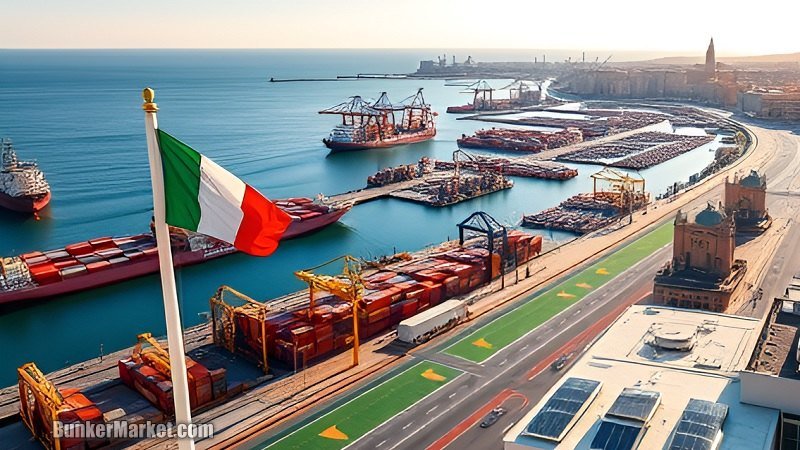
Italy becomes the first EU country to issue unified LNG and Bio-LNG Ship-to-Ship bunkering guidelines for all national ports, enhancing safety and sustainability in maritime operations: A Milestone for Maritime Decarbonization.
Rome, 28 May 2025 – In a landmark development for maritime energy policy and port operations, the Italian Ministry of Infrastructure and Transport (Ministero delle Infrastrutture e dei Trasporti, MIT) has published the “Guidelines for Ship-to-Ship Bunkering of Liquefied Natural Gas (LNG) and Bio-LNG in Italian Ports” — marking the first time in the European Union that a country has introduced standardized national rules for LNG and Bio-LNG bunkering across all its ports.
This decisive regulatory move represents a turning point not just for Italy’s maritime sector but for the broader European strategy to transition toward low-emission fuels and port sustainability. By establishing a uniform framework, Italy becomes the EU’s first mover in creating cohesive, port-wide regulations for LNG bunkering — a vital component in maritime decarbonization and fuel diversification.
Table of Contents
Raising the Bar: A Unified National Approach to LNG Bunkering
The newly issued guidelines are aimed at ensuring high safety standards, environmental responsibility, and operational clarity for STS refueling activities involving LNG and its renewable counterpart, Bio-LNG. They offer clear criteria for local Maritime Authorities (Capitanerie di Porto) to implement in port regulations across the country, covering:
- Safety protocols for ship-to-ship LNG and Bio-LNG bunkering
- Risk mitigation and emergency response planning
- Compatibility procedures between supplying and receiving vessels
- Staff training and certification requirements
- Operational zoning and environmental protections
These guidelines were developed collaboratively by the MIT with the General Command of the Port Authorities, the National Fire Brigade (Corpo Nazionale dei Vigili del Fuoco), and leading industry associations, ensuring both regulatory rigor and practical applicability.
This guidance complements and updates the older Circular Serie VII No.16 of 19 July 2002, aligning Italy’s maritime fuel regulation with the technological advances and safety practices required by modern LNG logistics.
Strengthening Italy’s Role in the Global Bunkering Landscape
Italy’s move comes at a time when the country is already strategically positioned as a major Mediterranean player in bunkering and maritime logistics. Ports such as:
- Genoa (northwest gateway to Europe)
- La Spezia and Livorno (key commercial and naval centers)
- Civitavecchia (cruise and ro-ro hub for central Italy)
- Naples and Taranto (southern bunkering and industrial ports)
- Augusta (one of Italy’s major oil & gas terminals)
- Trieste (a deep-water Adriatic port with strong energy trade ties)
…are now better equipped to scale up LNG and Bio-LNG bunkering infrastructure, thanks to a regulatory backbone that reduces fragmentation and boosts investor confidence.
Italy’s bunkering evolution is integral to its national energy strategy — with LNG offering dramatic reductions in CO₂, NOx, PM, and SOx emissions, and Bio-LNG providing an even more sustainable, carbon-neutral pathway for the shipping industry.
Industry Applauds: “A Game-Changer for Clean Marine Fuels”
The reaction from key industry players has been overwhelmingly positive. The clarity and consistency introduced by the new guidelines are seen as essential enablers for infrastructure investment and fuel transition planning.
Among the most notable voices of support was Fabio Ferrara, Head of Marine Fuels and Bitumen at Enilive – ENI, one of Italy’s leading integrated energy companies and a key player in the advancement of alternative marine fuels
“The release of the new Guidelines for LNG STS Bunkering Operations in Italian Ports (EU) marks a pivotal moment for the maritime energy sector. For the first time in Europe, we now have a unified regulatory framework that applies to all national ports for ship-to-ship bunkering operations. This is a major step forward in ensuring safety, consistency, and sustainability as we accelerate the transition to cleaner marine fuels.“
Strategic Implications for Europe and Beyond
This move positions Italy as a regulatory model within the EU, potentially guiding similar frameworks in other Member States. It aligns closely with EU-wide decarbonization targets outlined in the Fit for 55 package, FuelEU Maritime, and the European Green Deal, and sets a standard for how countries can simultaneously pursue energy innovation and maritime safety.
For shipping operators, the guidelines bring a new level of predictability and planning capability. For LNG and Bio-LNG suppliers, the streamlined approach unlocks growth opportunities in terminal development, bunker vessel deployment, and cross-border trade.
Charting a New Course for Maritime Fueling in Europe
With the publication of the LNG and Bio-LNG STS Bunkering Guidelines, Italy has not only taken a firm step toward maritime decarbonization but has also offered the EU a replicable framework for safe and sustainable fuel transition.
As the maritime industry navigates a complex transition away from traditional fuels, the clarity, foresight, and cooperation underpinning Italy’s new guidelines provide both a regulatory foundation and a competitive advantage — anchoring the nation’s position at the forefront of Europe’s maritime energy future.
To access the full guidelines, Click Here to visit the official website of the Ministry of Infrastructure and Transport (Ministero delle Infrastrutture e dei Trasporti).
Source Ministero delle Infrastrutture e dei Trasporti – MIT