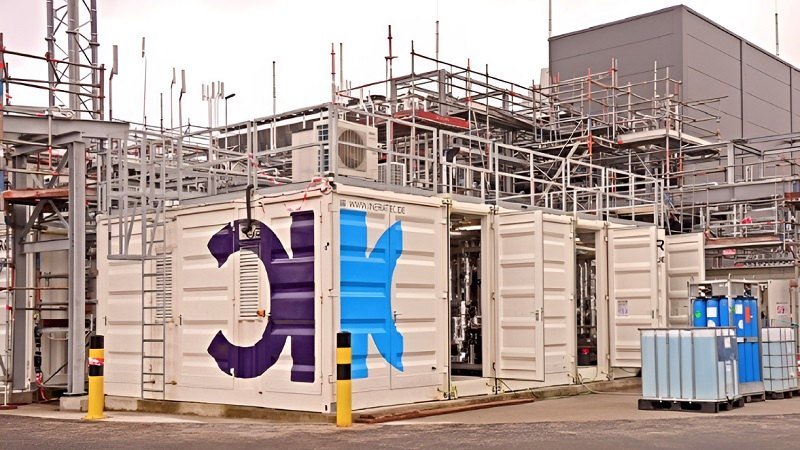
INERATEC, a leader in the field of sustainable synthetic fuels, has announced the successful production of the first liters of e-fuels and e-waxes at its newly commissioned commercial-scale Power-to-Liquid (PtL) plant in Frankfurt. This marks a significant breakthrough in the scale-up of PtL technology from pilot demonstration to industrial production and holds profound implications for the shipping, aviation, and chemicals sectors.
Located within an industrial complex in Frankfurt, this facility is not only INERATEC’s first commercial-scale site, but also stands as the largest PtL production plant in Europe—and globally. The plant is designed to produce up to 2,500 tons of sustainable e-fuels and e-waxes annually, leveraging renewable hydrogen and biogenic carbon dioxide (CO₂) to manufacture synthetic hydrocarbons. These are then refined into drop-in fuels, synthetic waxes, and chemical intermediates that are fully compatible with current fuel infrastructure, including marine fuel systems and bunkering operations.
“This first drop is an important sign—it marks the beginning of a new era in sustainable fuel production,” said Tim Böltken, Co-Founder and CEO of INERATEC. “With this plant, we are turning years of scaling into industrial reality, bringing synthetic fuels into use, and reducing our dependence on fossil resources.”
Table of Contents
From Pilot Plants to Industrial Production
Since its founding in 2016, INERATEC has deployed over a dozen pilot and demonstration plants, validating its technology in a variety of environments—from labs to mobile units. This new plant marks the transition to full-scale production, enabling the company to supply commercially relevant volumes of synthetic fuels to the market.
The company’s modular technology uses renewable electricity to generate green hydrogen via electrolysis, which is then combined with captured CO₂ to create synthetic hydrocarbons through the Fischer-Tropsch process. The resulting e-fuels are drop-in ready, requiring no modifications to existing engines, distribution networks, or bunkering infrastructure.
Implications for Maritime and Aviation Sectors
The shipping industry, under increasing pressure to decarbonize, stands to benefit significantly from INERATEC’s e-diesel and e-methanol solutions. Unlike traditional bunker fuels, these synthetic alternatives are climate-neutral—recycling CO₂ rather than introducing new carbon emissions into the atmosphere.
For international bunkering hubs and operators looking to align with IMO decarbonization targets and upcoming EU FuelEU Maritime regulations, INERATEC’s products offer a viable pathway to compliance without the need for extensive retrofitting.
Similarly, the aviation sector—where electrification faces practical limitations—will gain from INERATEC’s e-kerosene, a sustainable jet fuel option that supports carbon neutrality.
Strong Institutional and Financial Backing
The development of the Frankfurt facility was made possible with backing from a strong coalition of public and private supporters. These include the German Federal Ministry for the Environment, Nature Conservation and Consumer Protection (BMUV), the EU Innovation Fund, and the European Investment Bank (EIB). Additionally, INERATEC has attracted investment from high-profile private entities including Piva Capital, Breakthrough Energy Ventures, HG Ventures, ENGIE New Ventures, Safran Corporate Ventures, and Honda.
Global Expansion Underway
With the Frankfurt plant now operational, INERATEC is preparing to replicate its success internationally. Plans are in motion to launch additional production facilities worldwide in response to growing demand across sectors.
About INERATEC
INERATEC develops and operates scalable Power-to-X systems to produce sustainable, CO₂-neutral synthetic fuels and chemical products. By using renewable electricity and recycled carbon, the company offers a climate-friendly alternative to fossil fuels. INERATEC’s products are drop-in ready, offering a smooth transition to sustainable fuels for mobility and industry sectors without requiring infrastructure overhaul.
A Vision for Net-Zero Mobility
- Shipping: e-Diesel and e-Methanol enable emissions-free navigation, even beyond green corridors.
- Aviation: Sustainable kerosene supports decarbonization in hard-to-electrify sectors.
- Chemicals: Synthetic hydrocarbons can replace petroleum-derived feedstocks in chemical manufacturing.
Through its innovative technology and commitment to climate neutrality, INERATEC is driving the transition to a sustainable, defossilized future—on land, at sea, and in the air.
Source INERATEC