
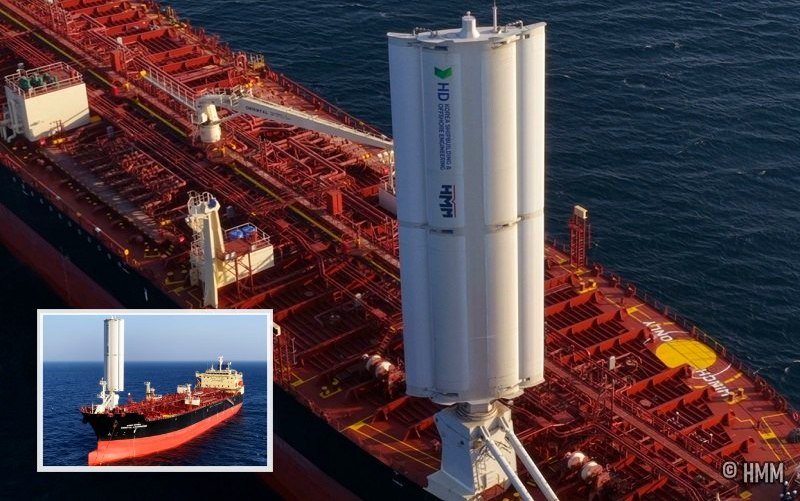
Seoul, Korea | January 12, 2026 – South Korean shipping giant HMM has officially commenced sea trials for its first Wind-Assisted Propulsion System (WAPS), marking a strategic shift toward hybrid power for its liquid and dry bulk fleet. The system, a domestically developed Wing Sail, was installed on the Oriental Aquamarine, a 50,000-dwt Medium Range (MR) tanker, which began operational voyages with the technology on January 5, 2026.
Developed by HD Korea Shipbuilding & Offshore Engineering (HD KSOE), the Wing Sail represents a significant leap in South Korea’s maritime technology sector. Unlike traditional soft sails, this rigid structure functions as an airfoil to harness aerodynamic lift, providing a direct reduction in the main engine load.
Table of Contents
Technical Specifications & Operational Design
The installation on the Oriental Aquamarine features a vertical wing-shaped structure approximately 30 meters in height and 10 meters in width. Key technical highlights include:
- Aerodynamic Lift: Similar to an aircraft wing, the system generates thrust from wind flow, which supplements the ship’s primary propulsion.
- Auxiliary Wing Integration: The design includes smaller auxiliary wings on both sides of the main structure to maximize wind utilization even at varying angles.
- Safety & Versatility: The unit features a tilting and folding function, allowing the sail to be lowered during severe weather conditions or when navigating under bridges and height-restricted port infrastructure.
- Suitability: The technology is optimized for vessels without deck cargo obstructions, such as tankers and bulkers, where clear deck space allows for maximum wind exposure.
Impact on Fuel Consumption and Emissions
From a bunkering and energy transition perspective, the integration of WAPS is expected to fundamentally alter the vessel’s fuel consumption profile. Depending on weather conditions and trading routes, HMM and HD KSOE project fuel savings between 5% and 20%.
These savings directly translate into a more favorable regulatory standing for the Oriental Aquamarine:
- CII (Carbon Intensity Indicator): Lower fuel burn per mile improves the vessel’s annual rating.
- FuelEU Maritime: The system supports compliance with the EU’s tightening Greenhouse Gas (GHG) intensity limits, potentially earning the vessel a “reward factor” that relaxes its overall intensity targets.
- GFI (Greenhouse Gas Fuel Intensity): Reduces the well-to-wake carbon footprint, aligning with the IMO’s 2030 and 2050 decarbonization goals.
Strategic Outlook: The Two-Year Trial
This installation is not merely a pilot but the precursor to a fleet-wide rollout. HMM will spend the next two years collecting high-fidelity operational data to verify the Wing Sail’s performance in real-world marine environments.
“Building on the low-emission technologies applied across our fleet, we will continue to advance the adoption of innovative solutions to further strengthen the long-term sustainability of our business,” HMM stated.
If the results meet performance benchmarks, HMM intends to expand the WAPS installation across its entire bulk fleet, complementing its existing investments in LNG and methanol-powered newbuilds.
About HMM
HMM is a globally recognized leader in integrated logistics and shipping services, offering a wide range of customized solutions for various cargo types, including container, bulk, and special cargo. The company operates a fleet of over 100 vessels, ensuring seamless and reliable shipping services across the globe. HMM’s commitment to sustainability, innovation, and customer-focused service positions it as a vital player in the future of the maritime industry.
Source HMM