
Global Top 10 Bunkering Ports 2024 Rankings Revealed: Singapore maintains dominance while Asian ports lead growth; Europe advances alternative fuels and digitalization
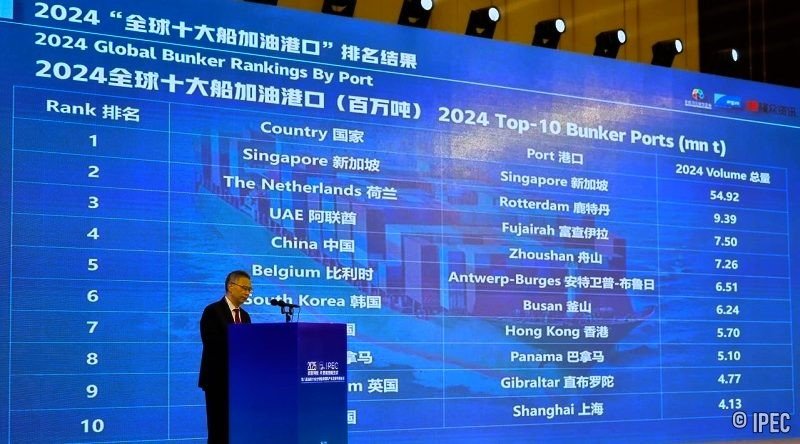
Zhoushan, China | October 22, 2025 – The 2024 Global Top 10 Bunkering Ports, revealed at the 8th International Petroleum and Natural Gas Enterprises Conference (IPEC) in Zhoushan, collectively reached 111.93 million MT, up +5.55% YoY. Singapore maintained its position as the world’s largest bunkering hub, while Asian ports including Zhoushan, Shanghai, and Hong Kong delivered the fastest growth.
The data highlights a broader structural shift in global bunkering:
- Asia continues to lead expansion, with ports integrating multi-fuel infrastructure, logistics optimization, and digitalization.
- Europe is pivoting toward alternative fuels, green corridors, and compliance-driven operations, while maintaining reliable conventional volumes.
- Middle East and the Americas retain strategic stability, with incremental volume growth and investments in supply chain resilience.
This ranking not only confirms regional performance, but also provides insights into technology adoption, energy transition readiness, and operational strategies, reflecting the evolving priorities of the global marine fuel market.
Table of Contents
2024 Global Top 10 Bunkering Ports (Million MT)
| Rank | Port Name | 2024 Volume | YoY Change | YoY Growth | Strategic Region |
| 1 | Singapore | 54.92 | +3.10 | +5.98% | Asia-Pacific |
| 2 | Rotterdam | 9.80 | -0.10 | -1.01% | Europe |
| 3 | Fujairah | 7.50 | +0.02 | +0.27% | Middle East |
| 4 | Zhoushan | 7.26 | +0.22 | +3.12% | Asia-Pacific |
| 5 | Antwerp-Bruges | 6.51 | +0.36 | +5.85% | Europe |
| 6 | Busan | 6.24 | +0.46 | +7.96% | Asia-Pacific |
| 7 | Hong Kong | 5.70 | +0.60 | +11.76% | Asia-Pacific |
| 8 | Panama | 5.10 | +0.19 | +3.87% | Americas |
| 9 | Gibraltar | 4.77 | +0.23 | +5.07% | Europe |
| 10 | Shanghai | 4.13 | +0.72 | +21.11% | Asia-Pacific |
Singapore: The World’s Mega-Hub Leaves Everyone Further Behind
Singapore reinforced its position as the world’s undisputed bunkering capital, achieving a record 54.92 million MT, nearly half of total top-10 volumes.
Key drivers of Singapore’s continued dominance
- Full digitalization of bunkering operations: Mandatory e-BDN (electronic Bunker Delivery Notes) increased transparency and efficiency, cutting disputes and time loss.
- Explosive growth in alternative fuels: Biofuel adoption accelerated, and LNG bunkering more than quadrupled, reinforcing Singapore’s position as a multi-fuel pioneer.
- Operational precision: Singapore’s regulatory rigor and environmental compliance have made it the preferred fueling point for liners on the Asia–Europe, transpacific, and intra-Asia corridors.
China’s Three-Engine Rise: Zhoushan, Shanghai, and Hong Kong
China is no longer an emerging contender, it is a rapidly advancing multi-port powerhouse.
Zhoushan (Rank 4): China’s flagship global hub
Volume: 7.26M MT (+3.12%) – Key factors:
- Full digitalization of bonded bunkering
- “Ten Achievements & Ten Initiatives” launched at IPEC 2025
- Drone-assisted delivery trials
- Expanded anchorage capacity in the Zhejiang FTZ
Zhoushan continues to anchor China’s international bunkering ambitions.
Hong Kong (Rank 7): A High-Velocity Comeback
Volume: 5.70M MT (+11.76%) – Boosted by:
- Regional trade recovery
- Fleet repositioning post-pandemic
- Greater Bay Area supply chain integration
Shanghai (Rank 10): The Fastest-Growing Port Globally
Volume: 4.13M MT (+21.11%) – Driven by:
- Surging container throughput
- Yangtze River Delta integration
- Rapid expansion in fuel availability and reliability
Shanghai is emerging as China’s highest-velocity growth engine.
Together, the three Chinese ports added 1.54M MT — the strongest national growth contribution worldwide.
Europe: Strong Green Transition
Europe’s major bunkering hubs reflect the tension between decarbonization leadership and conventional fuel decline.
Rotterdam (Rank 2): The Alternative Fuels Innovator (-1.01%)
Instead of signaling weakness, Rotterdam’s contraction reflects its aggressive pivot toward LNG, methanol, and future fuels mandated by Fit-for-55 and FuelEU Maritime.
Note: Rotterdam data (9.80m MT) was adjusted to include alternative fuels.
Antwerp-Bruges (Rank 5): A Regional Gainer (+5.85%)
Antwerp-Bruges captured regional share as ships adapt to stricter compliance zones and optimize European routing patterns.
Gibraltar (Rank 9): Reliable and Steady (+5.07%)
Gibraltar’s reliability continues to support its role as the primary chokepoint bunkering hub for Mediterranean–Atlantic flows.
Europe is no longer the center of volume — but it is the center of fuel innovation.
Middle East & Americas: Stability with Incremental Gains
Fujairah (Rank 3): Flat but Strong (+0.27%)
Fujairah remains the Middle East’s anchor hub, supported by its massive storage base and attractive security of supply, though growth has plateaued.
Panama (Rank 8): Moderate Growth (+3.87%)
Panama saw moderate volume increases despite water-level constraints at the canal, reflecting its indispensable geographic position.
Global Top 10 Bunkering Ports 2024 Market Performance: +5.17% Growth, Asia Dominates
Total volumes rose from 106.04M MT (2023) to 111.93m MT (2024).
| Metric | 2023 Total | 2024 Total | Aggregate Change |
| Total Top 10 Volume (Milllion MT) | 106.04 | 111.93 | +5.48 |
| Aggregate Growth | +5.55% |
Key insights
- No ranking positions changed, highlighting structural stability even amid strong volume shifts.
- Singapore alone accounted for 56% of global growth.
- China contributed 28%.
- Asia generated more than 80% of total expansion.
Volume Champions of 2024
Absolute Volume Leader
- Singapore: +3.10M MT
Fastest Growth Rate
- Shanghai: +21.11%
High-Velocity Regional Movers
- Hong Kong: +11.76%
- Busan: +7.96%
These results confirm Asia’s accelerating momentum.
Strategic Interpretation: A Global Realignment of Maritime Fuel Power
2024 confirms a fundamental structural shift:
- Asia has solidified its role as the global epicenter of bunkering.
- Europe is transitioning to a Alternative Fuels leadership model.
- The Middle East remains stable but no longer drives global growth.
- Digitalization is now a competitive necessity, not a differentiator.
Real-time fuel tracking, blockchain-secured e-BDNs, and AI-driven routing are rapidly becoming standard maritime infrastructure.
Future Outlook: AI, Decarbonization, and Multi-Fuel Infrastructure
Industry experts at IPEC emphasized that the next decade’s leadership will be decided by:
- AI-driven supply chain optimization: Autonomous scheduling, predictive demand, and algorithmic planning will reshape fuel logistics.
- Multi-fuel readiness: LNG, biofuels, methanol, ammonia will determine long-term competitiveness.
- Green corridors & compliance-driven bunkering routes: IMO 2030/2040 and EU FuelEU Maritime will fundamentally reconfigure global vessel behavior.
Conclusion: 2024 Marks the Rise of the Asian Bunkering Era
- Singapore has secured its lead.
- China has activated three major engines of growth.
- Europe is architecting the future of Alternative Fuels.
- The global shipping fleet is accelerating into a multi-fuel, digital, AI-integrated era.
The 2024 rankings released at IPEC 2025, organized by China Petroleum Circulation Association, that the future of global bunkering will be written in Asia, powered by digital intelligence, and defined by the race toward decarbonization.
The International Petroleum and Natural Gas Enterprises Conference (IPEC)
The International Petroleum and Natural Gas Enterprises Conference (IPEC), held annually in Zhoushan, China, is a pivotal international forum designed to promote the China (Zhejiang) Pilot Free Trade Zone and establish Zhoushan as a leading global resource allocation hub for oil, gas, and bulk commodities. The conference acts as the official stage for China to signal its strategic ambitions and rapid ascendance in the global maritime and energy value chain, particularly in marine fuel supply. IPEC is essential for high-level global cooperation, securing multi-billion-yuan project signings across the industrial chain, and serving as the primary venue for releasing influential global benchmarks, such as the rankings for top bunkering ports and global bunker suppliers.
Attendance and Impact
Since its 2017 inception, IPEC has consistently attracted global industry leaders, with attendance peaking in the pre-pandemic years (2018-2019, over 800 representatives) and strongly rebounding to the 500-600 range in recent years, including numerous Fortune Global 500 firms. This attendance confirms its status as an indispensable platform for networking and deal-making. By facilitating strategic partnerships between China’s NOCs and international energy giants, and officially publishing key market rankings, IPEC demonstrates its significant influence in shaping the dynamics of the world’s most dynamic energy market.
Source: IPEC 2025