
Singapore, 26 August 2025 — The Global Centre for Maritime Decarbonisation (GCMD) has unveiled a groundbreaking report detailing the world’s first comprehensive field trials of tracer technologies designed to secure marine biofuel supply chains against fraud. Conducted across key bunkering hubs including Singapore and Rotterdam, the trials validate the feasibility of integrating tracers into commercial marine biofuel operations without disrupting workflows or compromising fuel quality.
Pioneering field tests validate tracer technologies in real-world marine biofuel supply chains, setting new standards for fuel authenticity and quality assurance.
Table of Contents
About the Trials
The GCMD-led trials were conducted in Singapore, Rotterdam, and other major global bunkering hubs under real-world commercial conditions. These first-of-their-kind field tests confirmed that tracers can be successfully integrated into existing marine biofuel supply chain operations—without causing disruption or compromising fuel quality. The trials involved injecting tracer compounds at early points in the supply chain and tracking them through blending, storage, and onboard vessel use.
Why Trial Tracers?
Liquid biofuels such as FAME and HVO are among the most promising near-term solutions for decarbonising maritime transport. However, while sustainability certification schemes like the International Sustainability and Carbon Certification (ISCC) and the Roundtable on Sustainable Biomaterials (RSB) play a critical role in verifying emissions reductions, they currently lack physical, field-level verification mechanisms. This leaves supply chains susceptible to fuel adulteration and the risk of double-counted emissions reductions.
Tracer technologies provide a much-needed physical assurance layer, enabling stakeholders to verify both the authenticity and quantity of biofuels with scientific precision. By addressing these critical gaps, tracers support greater transparency, integrity, and trust in marine biofuel markets.
Three cutting-edge tracer technologies deployed in rigorous field trials
Over six supply chain trials, GCMD tested three distinct tracer candidates under authentic operating conditions to assess their effectiveness in verifying biofuel authenticity and quantity. The tracers—synthetic DNA (Tracer A), element-based metalloid (Tracer B), and non-fluorescent organic compound (Tracer C)—were introduced at the earliest stages of the supply chain and monitored through storage and onboard vessel usage.
- Tracer A (Synthetic DNA): While detected initially, its reliability diminished downstream, particularly onboard vessels, likely due to thermal degradation or contamination interference.
- Tracer B (Element-based Metalloid): Demonstrated strong resilience to harsh marine fuel environments and consistent detectability; however, quantification accuracy showed discrepancies of 30–40%, highlighting a need for further calibration.
- Tracer C (Organic Compound): Emerged as the most promising tracer, consistently detected at all sampling points with less than 5% variance from expected concentrations. Its robust performance, combined with cost-effectiveness and compatibility with standard Gas Chromatography-Mass Spectrometry (GC-MS) testing, positions it as the leading candidate for widespread industry adoption.
Addressing critical gaps in marine biofuel supply chain integrity
Marine biofuels such as Fatty Acid Methyl Esters (FAME) and Hydrotreated Vegetable Oils (HVO) represent some of the most viable short-term solutions for decarbonising maritime transport. These biofuels are compatible with existing infrastructure and regulatory frameworks like the EU RED II, yet current sustainability certifications rely heavily on documentation and lack physical, field-level verification. This creates vulnerabilities to biofuel adulteration and fraudulent claims, undermining trust and risking false greenhouse gas (GHG) emission reductions.
The GCMD trials respond directly to this challenge by providing an objective, scientific method to physically trace biofuel batches through the supply chain. This breakthrough not only enhances fraud prevention but also supports accurate GHG accounting and compliance.
Robust, scalable solutions for future-proofing marine biofuel markets
During the trials, a total of 10,400 metric tonnes of biofuel blends were bunkered, achieving an overall 24% reduction in GHG emissions compared to conventional fuels. The organic tracer’s proven reliability and scalability mark a pivotal step towards a trusted assurance framework for drop-in green fuels.
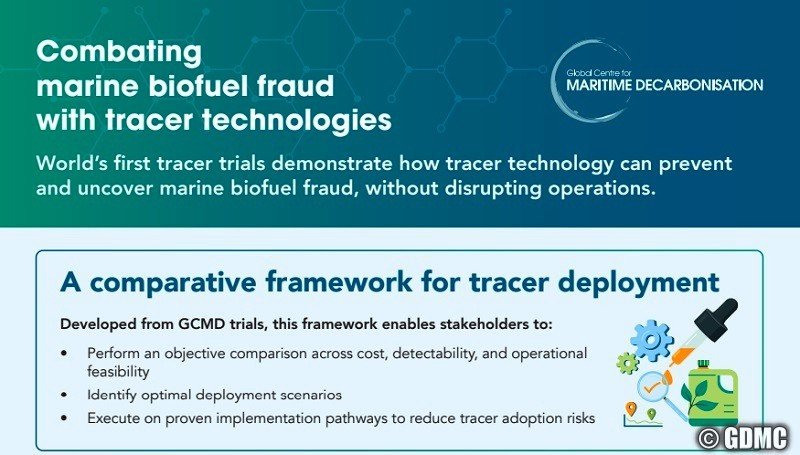
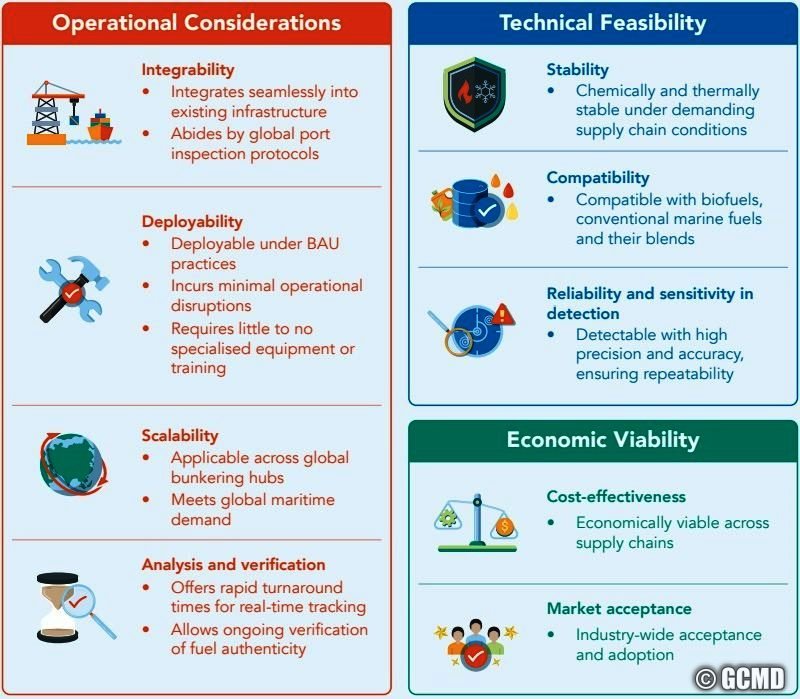
GCMD has developed a comparative benchmarking framework to assist stakeholders in choosing appropriate tracer technologies, weighing factors such as cost, detectability, and operational feasibility. The framework also outlines best practices for tracer deployment, including standardised dosing, sampling, detection protocols, and real-time data sharing to facilitate transparent auditing.
Industry-wide collaboration and regulatory backing vital for success
Professor Lynn Loo, CEO of GCMD, commented, “Our pilot programme has proven the practical viability of physical tracers in safeguarding marine biofuel supply chains. This achievement reflects the collaborative spirit of fuel suppliers, end-users, surveyors, laboratories, and tracer technology providers. By delivering robust, evidence-based verification methods, we are paving the way for greater confidence and accelerated adoption of sustainable marine fuels.”
To scale tracer deployment globally, GCMD advocates for strong institutional support, including legislation governing tracer use and harmonised standards across the industry. Seamless integration into existing bunkering workflows and digital verification platforms will be key to unlocking the full potential of this technology.
For more details and to access the full trial report, visit GCMD.
About GCMD
Established on 1 August 2021, the Global Centre for Maritime Decarbonisation (GCMD) is a non-profit organisation dedicated to accelerating maritime decarbonisation through innovation, standards development, and cross-sector collaboration. Headquartered in Singapore—the world’s largest bunkering hub—GCMD partners with industry leaders including BHP, BW Group, Eastern Pacific Shipping, DNV, Ocean Network Express, and Seatrium, with additional support from the Maritime and Port Authority of Singapore.
Since inception, GCMD has led multiple initiatives addressing ammonia fuel deployment, drop-in green fuel assurance, onboard carbon capture, and closing the data-financing gap for energy efficiency. The organisation continues to champion scalable solutions for a sustainable maritime future.