
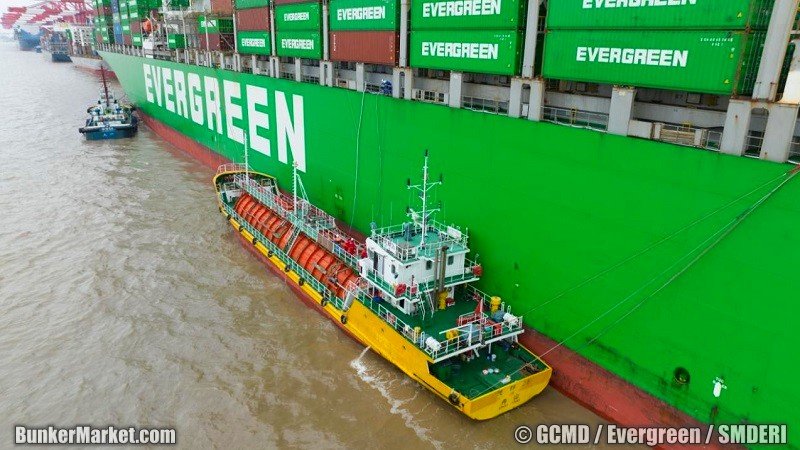
Singapore, 25 June 2025 — In a landmark achievement for maritime decarbonisation, the Global Centre for Maritime Decarbonisation (GCMD) and Shanghai Qiyao Environmental Technology Co., Ltd. (SMDERI-QET) have successfully completed the world’s first ship-to-ship (STS) transfer of liquefied carbon dioxide (LCO₂) captured directly from a ship’s exhaust. This milestone operation took place on 19 June 2025 aboard the vessel Ever Top, owned by Evergreen Marine Corporation, at Yangshan Port, Shanghai, and is being hailed as a pivotal advancement in onboard carbon capture and the downstream carbon value chain.
The STS operation marked the successful offloading of captured LCO₂ from a vessel using a cutting-edge onboard carbon capture system (OCCS), a process developed and operationalised through the collaboration between SMDERI-QET and GCMD. The trial not only validated key technical and operational parameters but also demonstrated the viability of integrating STS offloading into future maritime carbon management infrastructure.
Table of Contents
SMDERI-QET’s Role and Technology
As the technical lead of this groundbreaking demonstration, SMDERI-QET deployed its proprietary OCCS technology—capable of achieving over 80% CO₂ capture efficiency with 99.9% purity—to enable the safe and flexible offloading of captured carbon dioxide. By integrating precision STS transfer procedures, including manifold control, pressure regulation, and vessel positioning, SMDERI has addressed one of the industry’s biggest hurdles: enabling scalable carbon handling in ports with variable infrastructure readiness. This achievement not only validates the robustness of SMDERI’s systems but also sets the stage for global standardisation of shipboard carbon capture and transfer practices.
A World-First in Carbon Management at Sea
This unprecedented ship-to-ship offloading of LCO₂ represents a significant technical breakthrough. It brings to life a scenario envisioned in GCMD’s earlier feasibility study, which identified STS transfer as the most promising configuration for offloading captured carbon dioxide at scale.
“We are privileged to have participated in the world’s first ship-to-ship transfer of onboard captured LCO₂,” said Professor Lynn Loo, CEO of GCMD. “It was encouraging to see the trial adopt the configuration identified in our earlier study as the most promising approach for offloading captured CO₂ at scale. Now carrying the baton, we have taken the first steps in unlocking the carbon value chain by investigating the downstream handling of the captured CO₂, including its transport and utilisation.”
Scaling the Carbon Value Chain: Phase 2 Underway
Building upon the success of the STS transfer, GCMD has taken the lead in Phase 2 of the pilot project, focusing on the operationalisation of the downstream carbon value chain. This includes the safe and efficient transportation of LCO₂ and its reuse in industrial applications.
In this phase, the captured carbon dioxide is being utilised to produce low-carbon calcium carbonate, a sustainable building material increasingly valued for its reduced environmental footprint. This application not only demonstrates a viable commercial use case for captured carbon but also supports circular economy principles.
To provide an in-depth understanding of environmental impact, life cycle assessments (LCAs) are also being conducted to evaluate the greenhouse gas emissions reduction potential across the full value chain—from onboard capture, to offloading, transport, and final utilisation.
Multi-Stakeholder Collaboration: A Key to Success
The success of this groundbreaking trial was made possible by the concerted efforts of multiple industry stakeholders, including:
- Evergreen Marine Corporation
- Zhoushan Dejin Shipping Co. Ltd
- Greenore
- DNV
GCMD expressed its deep appreciation to all partners involved, recognising their dedicated efforts and pioneering spirit in advancing maritime decarbonisation technologies.
About SMDERI-QET
Shanghai Qiyao Environmental Technology Co., Ltd. (SMDERI-QET) is a key technology platform under China State Shipbuilding Corporation (CSSC), specialising in the development of marine environmental protection equipment. Its two core business lines—emission control and energy upgrading—underscore its commitment to helping the shipping industry reduce greenhouse gas and pollutant emissions.
SMDERI-QET is recognised globally for its advanced solutions such as the Exhaust Gas Cleaning System (EGCS) and Selective Catalytic Reduction System (SCR). As the industry moves towards a greener future, the company continues to innovate in areas like Fuel Gas Supply Systems (FGSS), Onboard Carbon Capture and Storage Systems (OCCS), LNG Sub-cooling Systems (LSC), and Methane Oxidation Catalysts (MOC).
Its vision is clear: lead through innovation, serve with excellence, and shape a sustainable maritime industry.
About GCMD
The Global Centre for Maritime Decarbonisation (GCMD) was established in August 2021 in Singapore—a global bunkering and transshipment hub—as a non-profit organisation dedicated to accelerating the decarbonisation of the maritime sector.
GCMD was founded by six leading industry players: BHP, BW Group, Eastern Pacific Shipping, Foundation Det Norske Veritas (DNV), Ocean Network Express, and Seatrium. GCMD also receives funding from the Maritime and Port Authority of Singapore (MPA) for qualifying research and development programmes and projects. Since its founding, bp, Hanwha Ocean, Hapag-Lloyd, NYK Line and PSA International have joined as Strategic partners
To date, over 130 project-level and centre-level partners have joined GCMD in support of its mission to close the technical and commercial gaps for low-carbon technologies in maritime shipping.
GCMD’s four key initiatives include:
- Deploying ammonia as a marine fuel
- Creating assurance frameworks for drop-in green fuels
- Unlocking the carbon value chain via shipboard carbon capture
- Closing the data-financing gap to scale up energy efficiency tech
This latest STS offloading trial marks a definitive leap forward in making maritime carbon capture, transport, and reuse a practical reality, accelerating progress toward IMO decarbonisation goals and paving the way for scalable deployment across the global fleet.
Source Global Centre for Maritime Decarbonisation | SMDERI-QET