

Singapore – 12 September 2025 – In a bold demonstration of its long-standing commitment to sustainable shipping, Eastern Pacific Shipping Pte. Ltd. (EPS) has successfully completed its 450th ship-to-ship (STS) LNG bunkering operation. The milestone operation was carried out with Segway, one of EPS’s latest dual-fuel newbuild tankers, and marks a significant step forward in the company’s transition to a lower-emission fleet.
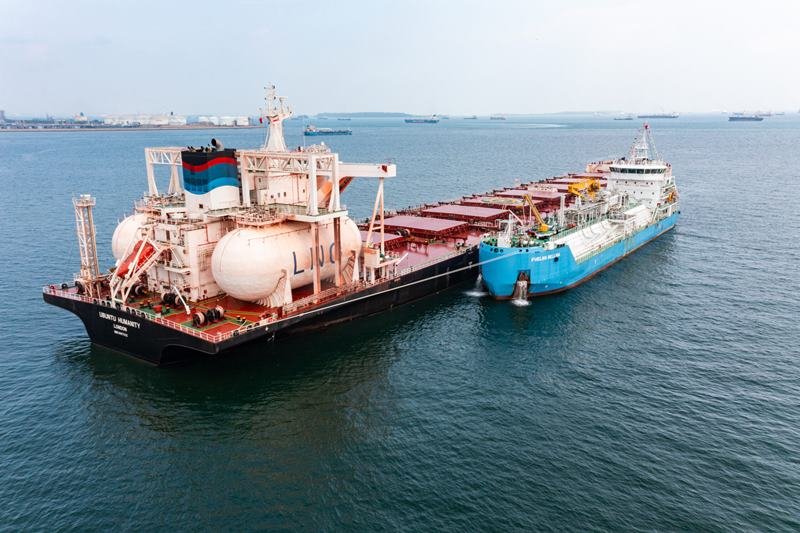
This accomplishment cements EPS’s position as one of the global leaders in LNG bunkering operations and showcases its operational excellence in integrating cleaner fuel alternatives into mainstream commercial shipping.
Table of Contents
From Pioneering to Benchmarking: EPS’s LNG Bunkering Journey
Since conducting its first LNG bunkering operation in 2020, EPS has rapidly scaled its use of liquefied natural gas (LNG) across its expanding dual-fuel fleet. From 250 bunkering operations in 2024 to this latest milestone at 450, EPS has shown consistent momentum in aligning its fuel strategy with global decarbonization targets.
The STS bunkering operation with Segway is particularly noteworthy as it reflects both technical proficiency and coordination across onboard and shoreside teams—elements essential to safe, compliant, and high-efficiency LNG bunkering procedures.
“This milestone is a reflection of our team’s firm commitment to safety, operational excellence, and environmental responsibility,” shared EPS. “Every LNG bunkering operation brings us closer to our net-zero vision and solidifies our leadership in maritime fuel transition.”
Why LNG Bunkering Matters for Maritime Sustainability
LNG is widely recognized as a key transitional fuel in the maritime sector, offering significant reductions in:
- CO₂ emissions (up to 20–25% compared to traditional marine fuels),
- Sulfur oxides (SOx) (virtually eliminated),
- Nitrogen oxides (NOx) and particulate matter, contributing to cleaner air around port cities and shipping lanes.
Ship-to-ship LNG bunkering, in particular, plays a vital role in enabling flexible refueling strategies for deep-sea vessels without interrupting tight voyage schedules. EPS’s mastery of STS operations showcases how this approach can be safely and efficiently scaled across large, ocean-going fleets.
The Role of “Segway”: EPS’s Next-Generation Tanker
The milestone was achieved aboard Segway, one of EPS’s most recent additions to its growing fleet of dual-fuel vessels. Built with cutting-edge energy efficiency technologies and LNG propulsion systems, Segway represents a new generation of tankers engineered for regulatory compliance and long-term carbon reduction.
Its participation in the 450th STS bunkering operation further emphasizes EPS’s strategy of future-proofing its fleet while ensuring reliable, low-emission transport solutions for global cargo.
Setting the Standard in LNG Bunkering Operations
Few companies in the maritime sector have operationalized LNG bunkering at the scale and speed of EPS. Behind every bunkering operation is a complex orchestration of:
- Fuel supplier coordination,
- Port approvals and compliance checks,
- Onboard technical readiness,
- Rigorous safety procedures, and
- Real-time operational communications.
EPS’s ability to execute these elements 450 times—and counting—demonstrates not just consistency but also strategic depth in managing alternative fuels across diverse vessel types and geographies.
This achievement contributes directly to the industry’s broader efforts to lower maritime GHG emissions in line with the IMO’s 2030 and 2050 climate targets, and reinforces LNG’s role as a mature, reliable option in today’s alternative fuel mix.
A Broader Commitment to Net-Zero
While LNG remains central to EPS’s fuel strategy, the company is also actively exploring additional decarbonization pathways, including biofuels, methanol, ammonia, and carbon capture-ready vessels.
Its integrated approach combines:
- Fleet renewal with dual-fuel vessels,
- Collaborations with global bunkering partners,
- Digital optimization tools, and
- Crew training for safe handling of alternative fuels.
With more than 21 million DWT under management and operations spanning containerships, bulkers, tankers, and car carriers, EPS is shaping the future of green shipping at scale.
Conclusion: Fueling a Cleaner Maritime Future
EPS’s 450th LNG bunkering operation is more than just a number—it’s a proof point of what is possible when innovation, commitment, and safety come together in maritime operations. As the shipping industry faces mounting regulatory and societal pressure to decarbonize, leaders like EPS are proving that LNG bunkering is not only viable—but scalable and effective.
With this milestone, EPS continues to raise the bar for how global shipping companies can integrate sustainability without compromising reliability or safety.
For the bunkering industry, this marks another leap forward—where LNG bunkering has evolved from pilot project to standard practice.
About Eastern Pacific Shipping (EPS)
Eastern Pacific Shipping is a Singapore-based global shipowner and operator with a fleet exceeding 21 million DWT. The company manages a wide range of vessel types including containerships, tankers, dry bulk carriers, and PCTCs. With a legacy of over 60 years and a team of more than 6,000 professionals worldwide, EPS is committed to leading the maritime energy transition through innovation, sustainability, and operational excellence.