
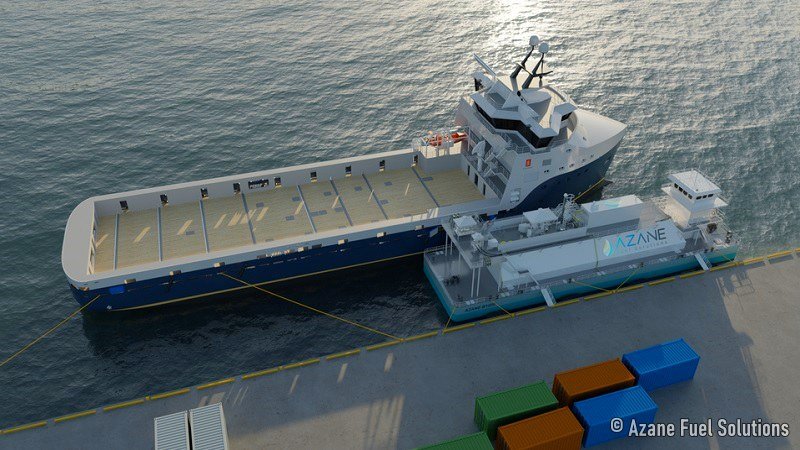
Norway | December 17, 2025 – State-owned energy and climate agency Enova has approved funding for the development of three large-scale ammonia bunkering facilities to be built and operated by Azane Fuel Solutions, creating what is set to become Europe’s first open-access ammonia bunkering network for commercial shipping.
The facilities will be located at Mongstad, Florø and Risavika along Norway’s west coast and are scheduled to be fully operational by 2029. Once commissioned, they will be available to all ammonia-capable vessels, Norwegian and international, without exclusivity, a move widely seen as a critical enabler for ammonia-fuelled shipping at scale.
Table of Contents
From Vision to Infrastructure: Breaking the Bunkering Deadlock
Ammonia has long been identified as one of the most promising zero-carbon fuels for deep-sea shipping. Yet despite growing interest from shipowners, engine manufacturers and regulators, progress has been slowed by the lack of bunkering infrastructure.
Norway’s intervention is designed to break this deadlock.
Vessels require reliable fuel availability before owners commit to newbuilds or conversions, while fuel suppliers hesitate to invest without guaranteed demand. By underwriting shared infrastructure through Enova, Norway is deliberately absorbing early-stage risk and accelerating market formation.
The initiative forms part of a broader national strategy to maintain Norway’s role as a leading maritime nation while transitioning away from fossil fuels.
Strategically Positioned for Offshore and Deep-Sea Trades
The three ammonia bunkering facilities are strategically positioned to serve North Sea offshore operations, coastal shipping and international deep-sea traffic:
- Mongstad – Norway’s largest oil and gas terminal and a major energy hub with established deep-water marine infrastructure
- Florø – a long-standing offshore supply base serving dense vessel traffic along the coast
- Risavika – located near Stavanger, at the heart of offshore service and energy-intensive maritime activity
Together, the locations form a coherent west-coast bunkering corridor capable of supporting the first generation of ammonia-fuelled vessels operating in Northern Europe.
Industrial-Scale Ammonia Bunkering
The facilities are being developed by Azane Fuel Solutions, a Norwegian technology company specializing in safe ammonia handling and bunkering systems.
Each installation will feature:
- Up to 2,000 cubic metres of refrigerated ammonia storage
- Bunkering rates exceeding 100 tonnes per hour
- Purpose-built safety systems tailored to ammonia’s toxicity and corrosive properties
The design philosophy mirrors today’s LNG bunkering standards, adapted for ammonia’s distinct risk profile. Fast bunkering rates will allow vessels to integrate ammonia fueling into normal port calls, rather than treating it as a specialized operation.
Public Backing – Enova Funding Sends a Market Signal
Enova has awarded NOK 442 million (approx. USD 40 million) in combined funding commitments for the three bunkering projects. Final investment decisions must be taken within 12 months, and developers are subject to strict milestones for execution and commissioning.
Norwegian Minister of Climate and Environment Andreas Bjelland Eriksen framed the move as both climate policy and industrial strategy:
“By supporting projects like this, we give the industry room to adopt new solutions. This cuts emissions, creates new opportunities for Norwegian technology, and strengthens maritime employment along the coast.”
The funding model reflects Norway’s broader approach: using public capital to unlock private investment in technologies that can later compete globally.
Infrastructure Unlocks Vessel Orders
Crucially, the bunkering investments are being matched by parallel support for new zero-emission vessels, reinforcing the value-chain approach.
Enova has confirmed funding for seven new vessels:
- Three ammonia-fuelled bulk carriers
- Four hydrogen-fuelled vessels
Together, these ships are expected to reduce emissions by 92,000 tonnes of CO₂ annually, before accounting for follow-on fleet orders inspired by their deployment.
Ammonia Enters the Bulk Trades
Among the most significant projects is Amon Bulk AS, established by Amon Maritime, which will build three Kamsarmax bulk carriers, a vessel segment central to global commodity shipping.
The ships will be equipped with dual-fuel main engines capable of operating on ammonia and will transport iron ore to the European steel industry. Amon Bulk has signed a letter of intent with Azane Fuel Solutions for ammonia supply, directly linking vessel investment with bunkering availability.
For the bulk sector, the move signals that ammonia is transitioning from pilot concepts to commercially relevant tonnage.
Hydrogen Develops in Parallel
While ammonia is positioned as a solution for long-distance, energy-intensive voyages, Norway is advancing hydrogen for short- and medium-range shipping.
- GMI Rederi is building two hydrogen-powered coastal bulk carriers using compressed hydrogen, fuel cells, batteries and wind-assisted propulsion.
- LH2 Shipping is developing two bulk carriers powered by liquid hydrogen, operating between Northern Norway and continental Europe.
These projects are supported by hydrogen production and bunkering infrastructure already approved by Enova from Tønsberg to Bodø.
Retrofitting Opens the Door for Offshore Fleets
In a move closely watched by offshore and service vessel operators, Enova has announced that retrofits will qualify for future support, provided they cut fossil fuel emissions by at least 50%.
This opens ammonia and hydrogen pathways to existing fleets, particularly offshore support vessels, without requiring costly newbuilds, an important signal for near-term decarbonisation.
Why the Global Bunker Market Is Watching
Norway’s ammonia bunkering programme stands out globally for three reasons:
- Open Access – The bunkering facilities are not tied to specific fleets or charterers, enabling broader market adoption.
- Industrial Scale – Storage volumes and bunkering rates are designed for commercial shipping, not pilots.
- Value-Chain Coordination – Infrastructure, vessels, fuel supply and public policy are being aligned simultaneously.
As international shipping faces tightening regulation under IMO and EU frameworks, the availability of credible, scalable bunkering solutions will be decisive. Norway is positioning itself not just as an early adopter—but as a global reference market for zero-carbon marine fuels.
The Beginning of a New Bunkering Era
Battery-electric ferries have already transformed short-sea shipping in Norway. LNG has reshaped offshore bunkering. Now ammonia and hydrogen are moving from strategy decks into ports and pipelines.
As Enova’s maritime leadership puts it: the industry is shifting “from words to action.”
For the global bunkering sector, Norway’s west coast may soon become the place where ammonia transitions from promise to practice, and where the blueprint for the next generation of marine fuel infrastructure is written.
“Now that the industry knows there will be more well-located bunkering facilities along the coast, it becomes easier to invest in and build vessels. This will accelerate the necessary transformation now taking place at sea,” said Børge Noddeland, Head of Enova’s Ammonia Bunkering Infrastructure Programme.
About Enova
Enova SF is a Norwegian state-owned enterprise supporting Norway’s transition to a low-emission society. The agency funds innovative projects, including renewable energy, zero-emission shipping, and energy-efficient technologies.
About Azane Fuel Solutions
Azane Fuel Solutions was founded by two industry veterans with decades of experience in shipping, gas handling, and gas transfer. The company has developed cutting-edge technology that offers fast, safe, and flexible bunkering of ammonia, positioning it as a leader in the emerging market for ammonia as a maritime fuel. Azane is committed to building a comprehensive ammonia fuel bunkering network and is already leading the way with its highly advanced infrastructure projects in Norway. These projects are not only the most mature in the country but are also the first to receive safety approval from regulatory authorities.
With its innovative solutions and strong strategic partnerships, Azane is poised to play a key role in decarbonizing the shipping industry, ensuring a cleaner, more sustainable future for global maritime transport.
Source: Azane Fuel Solutions | Enova