
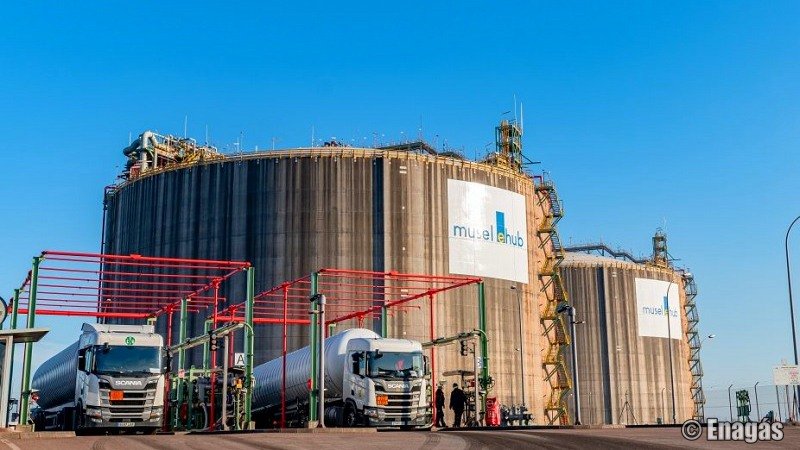
Gijón, Spain | November 4, 2025 – The Musel Energy Hub terminal in the Port of Gijón, an integrated LNG facility jointly owned by Enagás (75%) and Reganosa (25%), has reached a major milestone with the launch of a dedicated service to supply BioLNG to ships and tankers. This development represents a decisive step toward advancing the European Union’s decarbonisation objectives for the maritime sector and firmly positions the terminal as a central hub in Spain’s and Europe’s transition to cleaner, more sustainable marine energy.
The new BioLNG bunkering service, officially available from November 5, enables the terminal to load liquefied biomethane—produced from organic waste—onto vessels and tankers, marking a major step toward the use of renewable fuels in maritime transport. Through the interconnected national gas network, biomethane injected upstream can be certified and recognised as BioLNG, ensuring full traceability and sustainability under European standards.
Table of Contents
A Multi-Molecule Milestone for Spain’s North Coast
Antonio Manzano, Managing Director of Musel Energy Hub, described the launch as a “new milestone in the development of the Gijón terminal as a multi-molecule plant.”
“This is a clear step forward in our commitment to advancing European decarbonisation goals,” Manzano said. “At the same time, it strengthens the competitiveness of this strategic infrastructure, ensuring energy security for both Spain and Europe.”
Nieves Roqueñí, President of the Port Authority of Gijón, emphasized the project’s strategic relevance for shipping companies operating in northern Spain.
“Preparing the regasification plant to supply BioLNG allows dual-fuel and LNG-adapted vessels to refuel in Gijón,” Roqueñí stated. “This aligns perfectly with our objective of reducing the carbon footprint of port operations. Gijón’s central position on Spain’s northern coast—with direct access to Atlantic maritime routes—makes it an ideal multi-energy hub to drive Europe toward climate neutrality.”
Certified Sustainability and Traceability
The new service complies with all International Sustainability and Carbon Certification (ISCC EU) and European Commission requirements, covering environmental, social, and traceability criteria for renewable fuels. This guarantees that the BioLNG supplied through the Musel terminal is fully aligned with EU sustainability frameworks.
Bunkering Growth Accelerates Across Spain
Spain’s LNG bunker market has witnessed exponential growth in recent years. Between 2022 and 2025, activity has expanded more than tenfold, reflecting the shipping industry’s rapid transition to cleaner fuels.
Between January and September 2025, a total of 4.6 TWh of LNG were supplied from terminals operated by Enagás and Reganosa, of which 4.1 TWh were delivered via Ship-to-Ship (STS) operations and 0.5 TWh through Truck-to-Ship (TTS) refuelling.
The addition of BioLNG to this portfolio is expected to consolidate Spain’s leadership in sustainable bunkering, creating new opportunities for innovation and green growth within the maritime sector.
A Decade of Progress Toward Maritime Decarbonisation
For Enagás and Reganosa, this achievement caps more than a decade of continuous investment and innovation. Both companies have been at the forefront of developing small-scale LNG infrastructure across Spain’s terminal network, adapting facilities to meet evolving market demands.
In parallel, they have actively collaborated on shaping the regulatory and procedural frameworks governing LNG and BioLNG ship refuelling, contributing to Europe’s broader transition toward a low-carbon maritime industry.
Port Landscape and Strategic Location
Situated approximately 6 km northwest of Gijón’s city centre, the port of Gijón benefits from a naturally sheltered indentation protected by Capes Torres and Peñas. Its artificial deep-water harbour provides extensive quays and terminal land, including a new continuous berth with a 23m charted depth, allowing year-round accommodation of large vessels like Cape-size bulkers and LNG carriers. The port is a critical node for trade, connecting directly to the A-8/A-66 motorway corridors and the national rail network, underscoring its pivotal role in the energy and logistics security of both Spain and Europe.
Toward a Cleaner, Competitive Future
With BioLNG now available from the Musel Energy Hub, Gijón is set to become a key supply point for renewable maritime fuels in the Atlantic corridor—strengthening Spain’s role in the global energy transition and providing shipowners with practical, low-carbon alternatives to conventional marine fuels.
The launch of BioLNG bunkering at the Port of Gijón marks not just a technical achievement, but a tangible leap forward in the decarbonisation of European shipping.
Port of Gijón (El Musel)
The Port of Gijón, also known as El Musel, is one of the main seaports on the Atlantic Arc and a strategic gateway on Spain’s north-coast Cantabrian shore. It is the leading Spanish port for the movement of solid bulk cargo, specializing in imports of coal and iron ore, while also handling liquid bulk, cement, steel, containers, and cruise traffic.
Musel Energy Hub (Musel E-Hub)
The Musel Energy Hub is a key LNG plant and energy infrastructure asset strategically located in the Port of Gijón. It is a joint venture, with Enagás holding 75% and Reganosa holding 25%. The hub is designed to be a multi-molecule terminal, reinforcing Spain’s security of energy supply and playing a crucial role in the global decarbonisation process. With facilities capable of accommodating large LNG carriers, the Musel E-Hub is a committed driver of sustainability, focusing on new services like BioLNG bunkering to facilitate the maritime sector’s shift towards cleaner, more sustainable fuels.
Reganosa
Reganosa is an energy company certified as a European Transmission System Operator (TSO) that develops and manages energy infrastructures. Its core business guarantees the diversification of supply and the correct operation and development of gas transmission infrastructure, which is being prepared to support technologies like hydrogen and biomethane. Reganosa provides comprehensive services, including operation and maintenance (O&M), network simulation, and consultancy for energy infrastructures globally, with a focus on developing sustainable and digital solutions that align with the European Union’s emission mitigation targets.
Enagás
Enagás is a Spanish energy company and a certified European Transmission System Operator (TSO). With over 50 years of experience, the company is an international leader in the development, operation, and maintenance of energy infrastructure, managing Spain’s main gas grid, multiple LNG regasification terminals, and underground storage facilities. Enagás contributes significantly to security of supply and the global decarbonisation process. The company is actively focusing on the transition to a carbon-neutral economy, including the development of a Hydrogen Transmission Network Operator (HTNO) role, and has set a goal to achieve Net Zero emissions by 2040 for Scopes 1 and 2.
Source: Enagás