
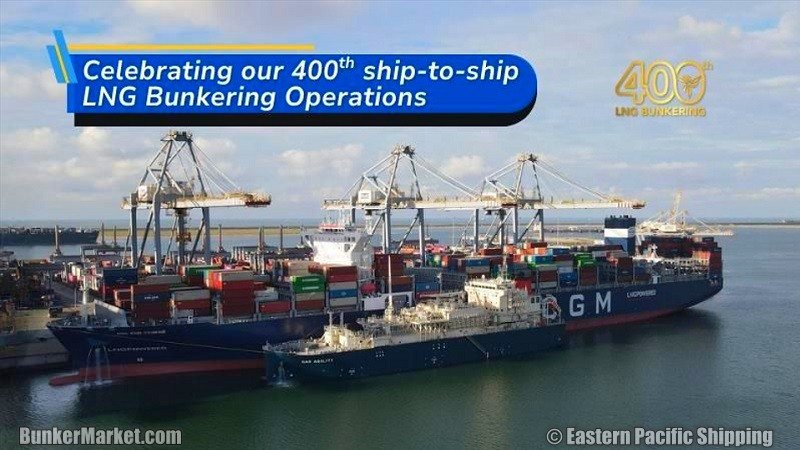
Eastern Pacific Shipping celebrates its 400th global STS LNG bunkering operation, reinforcing its leadership in sustainable and low-emission maritime transport.
Eastern Pacific Shipping (EPS), a leading global shipping company headquartered in Singapore, has marked another major milestone in its decarbonization journey with the successful completion of its 400th ship-to-ship (STS) LNG bunkering operation. This latest operation was carried out in France, involving EPS’s 15,000 TEU dual-fuel containership, CMA CGM Iguacu, during simultaneous cargo handling.
The achievement underscores EPS’s consistent momentum in adopting Liquefied Natural Gas (LNG) as a viable marine fuel solution and highlights the company’s continued investment in sustainable shipping operations worldwide.
Table of Contents
Operational Efficiency & Emissions Reduction
The 400th bunkering operation further demonstrates the operational maturity and coordination behind EPS’s LNG strategy. By performing LNG bunkering in parallel with cargo operations, EPS maximizes port efficiency while minimizing downtime, reflecting the company’s operational agility and focus on reducing its environmental footprint.
EPS’s growing LNG-powered fleet includes a range of vessel types, and each bunkering milestone represents another step in the company’s efforts to reduce harmful maritime emissions, including CO₂, sulfur oxides (SOx), and nitrogen oxides (NOx). The deployment of large dual-fuel container vessels like the CMA CGM Iguacu reinforces LNG’s role in scaling up cleaner energy use across global trade routes.
LNG as a Growing Marine Fuel Solution
As regulatory pressure intensifies under frameworks such as IMO 2030, IMO 2050, and regional emissions controls in the EU and North America, LNG continues to gain traction as a transitional fuel for the maritime sector. The global fleet of LNG-powered vessels has expanded significantly, with STS LNG bunkering becoming more widespread across Asia, Europe, and the Americas.
EPS is among the front-runners in mainstreaming LNG operations, both from a technical readiness and infrastructure collaboration perspective. These consistent bunkering milestones demonstrate the increasing normalization of LNG across major container, car carrier, and tanker fleets.
While LNG is not the final solution in the transition to zero-carbon shipping, it serves as an important bridge fuel. It allows shipping lines to meet immediate emissions requirements while preparing for the introduction of next-generation fuels such as ammonia, hydrogen, bio-LNG, and synthetic alternatives.
EPS’s Sustainability Strategy in Action
From its first LNG bunkering operation just four years ago to reaching its 400th today, EPS has shown both speed and scale in rolling out LNG capabilities across its global operations. The achievement reflects a broader company strategy focused on:
- Fleet modernization through dual-fuel engine adoption
- Port collaboration to expand bunkering access
- Operational integration to ensure minimal disruption during bunkering
- Global partnerships that promote clean energy shipping corridors
Each operation builds on a company-wide ethos of innovation, collaboration, and responsibility—cornerstones of EPS’s long-term goal of achieving net-zero emissions.
About Eastern Pacific Shipping
Eastern Pacific Shipping (EPS) is a global shipping company headquartered in Singapore with a fleet exceeding 21 million DWT. Operating a wide range of vessel types—including containerships, dry bulk carriers, tankers, and Pure Car and Truck Carriers (PCTCs)—EPS is known for being a pioneer in sustainability and clean fuel adoption within the maritime industry.
With a workforce of over 6,000 people and a strong focus on innovation and environmental responsibility, EPS continues to play a leading role in shaping the future of global shipping.
Source Eastern Pacific Shipping