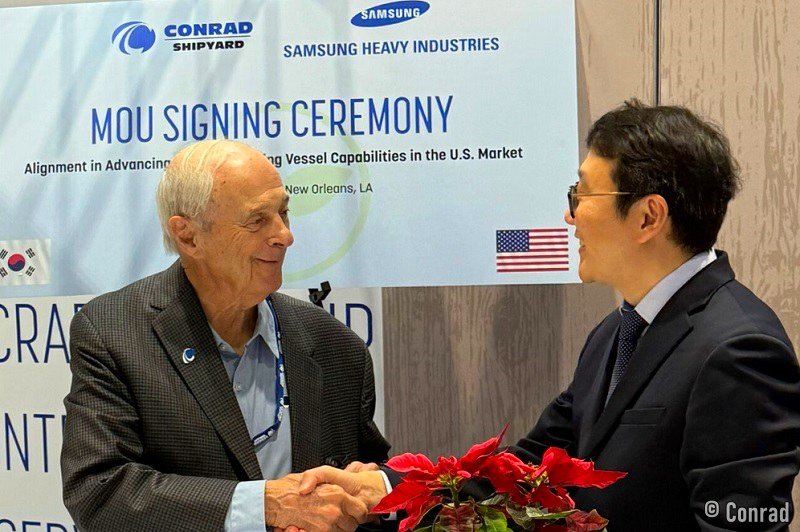
Morgan City, Louisiana | December 4, 2025 – In a move set to influence the future of the U.S. alternative-fuel bunkering landscape, Conrad Shipyard, LLC and Samsung Heavy Industries Co., Ltd. (SHI) have signed a Memorandum of Understanding (MOU) to jointly develop a new generation of LNG bunkering vessels tailored for American regulatory and commercial requirements.
The MOU establishes a collaborative framework enabling the two shipbuilding leaders to evaluate vessel designs, commercial models, and market opportunities that support the growing demand for LNG bunkering capacity in the United States. The partnership unites Conrad’s long-standing domestic shipbuilding strength with SHI’s advanced LNG engineering expertise.
Table of Contents
Global Expertise Meets U.S. Shipbuilding Mastery
The alliance brings together two complementary forces in modern shipbuilding. SHI contributes decades of experience in designing and constructing technologically advanced LNG carriers and energy-efficient vessels. Conrad provides deep knowledge of U.S. regulatory processes, proven LNG shipbuilding capability, and strong access to the domestic maritime market.
Together, the partnership is positioned to deliver American-built vessels that meet the operational and environmental demands of emerging LNG bunkering hubs.
Strengthening the U.S. LNG Bunkering Landscape
Under the terms of the MOU, Conrad and SHI will pursue opportunities to develop fully U.S.-compliant LNG bunkering vessels, addressing a critical infrastructure requirement as American ports prepare for a surge in LNG-fuelled ship calls.
An SHI representative noted that the collaboration will not only support the company’s entry into the U.S. LNG bunkering sector but also contribute to the broader revitalization of American shipbuilding capabilities.
“We are honored to collaborate with Samsung Heavy Industries,” added Johnny Conrad, Executive Chairman of Conrad Shipyard. “This partnership reflects our commitment to advancing innovative marine solutions and positions both organizations to deliver LNG bunkering assets aligned with the evolving needs of the market.”
LNG as a Marine Fuel: A Cornerstone of Shipping’s Energy Transition
The strategic significance of this MOU is underlined by the explosive growth of LNG as a viable, transitional marine fuel. Driven by the enforcement of the IMO 2020 sulfur cap and increasing global pressure to decarbonize shipping, the maritime industry has made a decisive pivot toward cleaner energy sources.
LNG offers a significant environmental advantage, virtually eliminating sulfur oxides SOx and particulate matter, and reducing nitrogen oxides NOx by up to 90% compared to conventional marine fuels. It also provides up to 20% lower CO2 emissions, positioning it as a key steppingstone on the path to net-zero shipping.
LNG’s maturity as a fuel, supported by worldwide production, storage, and transportation infrastructure, provides a level of reliability and scalability not yet matched by emerging alternatives. Advancements in methane-slip reduction technologies, combined with the future availability of bio-LNG and synthetic LNG, further enhance its role as a bridge toward long-term low- and zero-carbon shipping solutions.
A Rapidly Expanding Global LNG Bunker Market
The global LNG bunkering sector continues to grow at pace as more vessel operators adopt LNG propulsion across container, tanker, cruise, and offshore segments.
Key global market indicators include:
- More than 1,300 LNG-capable vessels in the worldwide fleet.
- Nearly 200 ports offering LNG bunkering services across Europe, Asia, and the Middle East.
- A steadily expanding fleet of dedicated LNG bunkering vessels, enabling ship-to-ship and terminal operations in major maritime corridors.
- A global LNG bunkering market valued at over $11.5 billion in 2024, with a projected CAGR exceeding 40% through 2032.
- Over 640 LNG-powered vessels (excluding LNG carriers) in operation today, expected to surpass 1,200 by 2028 as adoption accelerates.
These trends underscore the need for additional bunkering capacity, technologically advanced vessels, and port infrastructure—factors directly addressed by this new U.S.–Korea shipbuilding partnership.
U.S. LNG Bunkering Outlook: A Market Entering Rapid Expansion
Although Europe and Asia currently lead global LNG bunkering activity, the United States is entering a decisive growth phase. Regulatory pressure, port decarbonization strategies, and a steady rise in LNG-powered vessel traffic are driving demand for modern bunkering infrastructure across the Gulf Coast, East Coast, and Pacific gateways.
The U.S. LNG bunkering market, while still emerging, is projected to grow at a CAGR exceeding 10% through 2030. Major ports are investing heavily in LNG readiness, supported by the nation’s substantial natural gas resources and its strategic positioning along global trade routes. However, one of the market’s most significant constraints is the limited number of dedicated LNG bunkering vessels (LNGBVs) available to meet swelling fuel-supply requirements.
The Conrad–SHI partnership arrives at a pivotal moment. By pairing U.S. shipyard capacity with world-class LNG vessel technology, the collaboration directly addresses the nation’s supply gap and advances the availability of high-specification, American-built bunkering vessels. This alignment positions the United States to accelerate LNG adoption and strengthen its role in the global transition toward cleaner marine fuels.
About Samsung Heavy Industries (SHI)
Samsung Heavy Industries, is one of the world’s foremost shipbuilders, headquartered in South Korea. The company is recognized globally for its advanced engineering capabilities and is a leader in building complex commercial vessels, including large-scale LNG carriers, Floating LNG (FLNG) units, offshore structures, and specialized digital ship solutions. SHI’s reputation is built on delivering high-efficiency vessel technologies that shape the future of global shipping.
About Conrad Shipyard
Conrad Shipyard, established in 1948 and headquartered in Morgan City, Louisiana, is a premier U.S. shipbuilder operating five shipyards across southern Louisiana and Texas. Conrad designs, builds, and overhauls a wide variety of steel marine vessels for commercial and government customers, including barges, dredges, tugboats, ferries, and offshore supply vessels. Notably, Conrad has established itself as an early leader in the domestic LNG sector, having been involved in the construction and engineering of LNG bunkering infrastructure.
Source: Conrad Shipyard