
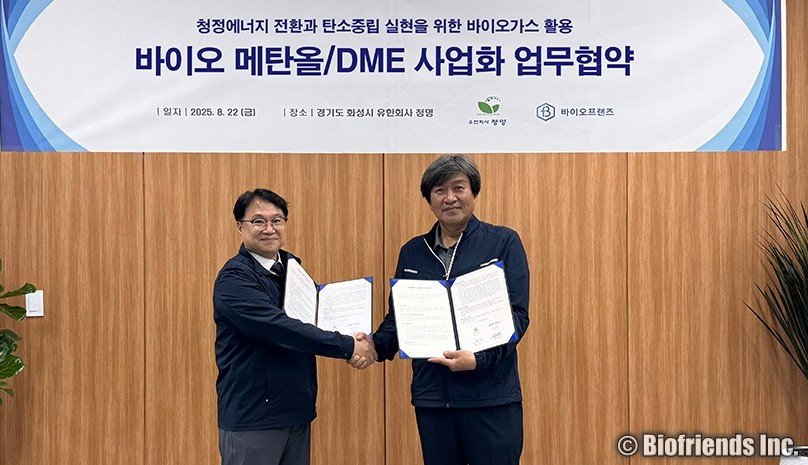
August 22, 2025 – Gunsan, South Korea — In a groundbreaking move set to redefine the landscape of eco-friendly marine fuels, Biofriends Inc. (Bio Friends) and Cheongmyeong Co., Ltd. have officially signed a Memorandum of Understanding (MOU) to build South Korea’s first commercial-scale biogas-based methanol production plant. This milestone agreement signals a significant shift toward carbon-neutral fuel solutions, not only for domestic industries but also for the global shipping sector.
This landmark initiative marks a new era for the bunkering and maritime energy sectors in Asia, as the project pioneers the transformation of domestically produced biogas into biomethanol—a sustainable, low-emission marine fuel with global potential.
Table of Contents
Turning Biogas into Marine-Grade Methanol: A Vision Realized
Under the agreement, Bio Friends—an innovator in clean fuel technologies—and Cheongmyeong—a leader in Korea’s K-biogas sector—will collaborate to design, build, and operate a plant capable of producing 60,000 to 80,000 tons of biomethanol annually. The facility will be located at Bio Friends’ existing site in Gunsan, utilizing 120,000 Nm³ of biogas per day from an on-site digester.
This strategic partnership is the culmination of an extensive feasibility study previously conducted by Bio Friends, which assessed the potential of scaling production from 45,000 to 100,000 tons per year. Based on those findings, the decision to commit to a commercial-scale operation reflects both the technical viability and growing demand for renewable marine fuels.
At the heart of this operation lies Bio Friends’ proprietary synthesis gas conversion technology, which converts methane (CH₄) and carbon dioxide (CO₂) into synthesis gas (syngas), which is subsequently refined into methanol. The process represents a key component of Carbon Capture & Utilization (CCU), transforming harmful greenhouse gases into high-value, eco-friendly energy.
Driving the Maritime Decarbonization Agenda
The significance of this development extends far beyond national borders. With the International Maritime Organization (IMO) tightening decarbonization targets under its revised GHG Strategy, alternative fuels like biomethanol are increasingly seen as essential to the future of sustainable shipping.
Initially, the biomethanol produced at the Gunsan plant will be supplied for use in methanol-powered domestic vessels, directly contributing to the decarbonization of South Korea’s shipping fleet. The move is expected to strengthen the global competitiveness of Korean shipbuilders and operators as they adapt to stringent international emissions standards.
In addition, part of the biomethanol output will be converted into dimethyl ether (DME)—a clean fuel alternative to liquefied petroleum gas (LPG). When blended with LPG, DME drastically cuts emissions of SOx, NOx, and CO₂, while leveraging existing LPG infrastructure due to its similar physical properties.
This dual-use strategy enhances the project’s environmental and economic impact, creating synergies across the marine fuel, industrial energy, and urban heating sectors.
Paving the Way for a Green Energy Future
MinSu Na, CEO of Cheongmyeong, emphasized the project’s alignment with national sustainability goals “In line with the current administration’s key pledge to proactively address the climate crisis for future generations, we will continue to build biogas production facilities that recycle organic waste resources and transform into a specialized supplier of eco-friendly, renewable energy raw materials.””
WonJun Cho, CEO of Bio Friends, highlighted the innovation at the core of the initiative “The core of this project lies in the Carbon Capture & Utilization (CCU) process, which converts biogas methane (CH₄) and carbon dioxide (CO₂) together to create synthesis gas (syngas), which is then converted into methanol.” He emphasized, “This is a first in Korea to simultaneously utilize greenhouse gases to produce high-value-added clean fuel, and it is a technology that is competitive in the global market.””
Implications for the Bunkering Industry
For the global bunkering industry, this development could mark a pivotal transition. As ports and shipping companies worldwide race to decarbonize operations and diversify fuel portfolios, biomethanol emerges as a drop-in-ready, scalable alternative that meets IMO regulations and ESG mandates without requiring massive infrastructure overhauls.
The upcoming facility in Gunsan may serve as a model for future biogas-to-methanol bunkering hubs, potentially enabling regional fuel supply chains across East Asia, and further integrating bio-based methanol into the maritime sector’s energy mix.
A Turning Point in Maritime Fuel Innovation
With the signing of this MOU, Bio Friends and Cheongmyeong are setting the stage for South Korea’s emergence as a leader in sustainable fuel production, leveraging innovation, circular economy principles, and environmental responsibility. As the global shipping industry accelerates toward a low-carbon future, initiatives like this are not just timely—they are essential.
For stakeholders in the bunkering Industry, this development is one to watch closely, as biomethanol transitions from experimental to essential, and Korea positions itself at the forefront of the maritime energy transition.
About Cheogmyeong Corporation
Cheongmyeong Corporation is a leading engineering and construction firm with a strong track record of successful industrial and infrastructure projects. The company is committed to embracing innovative and sustainable technologies to meet the evolving needs of the energy sector.
About Biofriends Inc.
Biofriends Inc. (Bio Friends), established in November 2016, is a South Korea-based company specializing in clean fuel and renewable energy solutions. Its core operations include the production and supply of Dimethyl Ether (DME), hydrogen extraction technologies, CCU (Carbon Capture & Utilization), and alternative fuel research. The company is committed to reducing harmful environmental emissions and advancing sustainable energy systems through nature- and human-centered energy engineering.
With facilities across Daejeon, Seoul, and Chungcheongbuk-do, Biofriends is actively developing next-generation fuel technologies that support carbon neutrality and a greener future.
Source Biofriends Inc.