
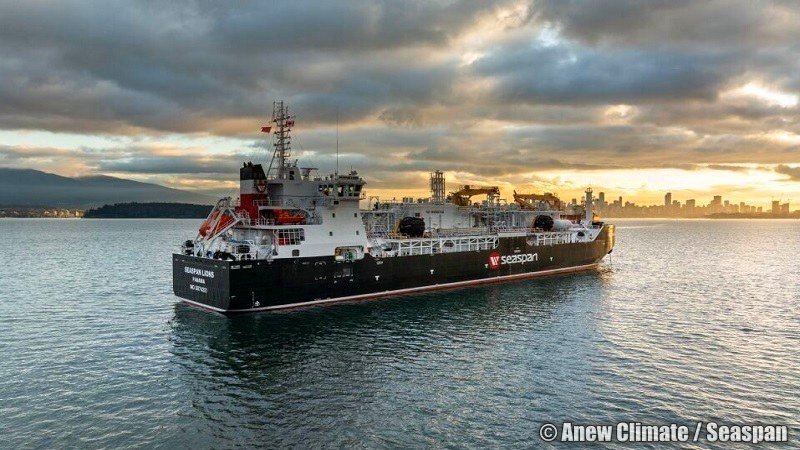
North Vancouver, B.C. – In a landmark development poised to reshape sustainable marine fuel supply on the West Coast of North America, Anew Climate, a global leader in climate solutions, and Seaspan Energy, a foremost marine bunkering provider, have announced a strategic partnership to deliver certified renewable liquefied natural gas (R-LNG) to shipping customers. This collaboration represents a market-first, scalable solution designed to help shipowners significantly reduce carbon emissions in line with increasingly stringent regulatory frameworks.
Table of Contents
Partnership Overview and Technical Collaboration
The alliance combines Anew Climate’s expertise in sourcing and certifying renewable natural gas (RNG) with Seaspan Energy’s established marine logistics and bunkering infrastructure. Anew will supply RNG certified under the International Sustainability and Carbon Certification (ISCC) — an internationally recognized standard that ensures traceability, sustainability, and low carbon intensity throughout the RNG supply chain. To facilitate seamless certification, Anew will also provide Seaspan with pre-audit support services essential for ISCC compliance, guaranteeing supply chain integrity from production through marine delivery.
Seaspan Energy will leverage its robust ship-to-ship LNG bunkering capabilities, positioning itself as the primary distributor of this certified R-LNG to maritime customers operating along the Pacific Northwest corridor. This integration extends Seaspan’s fuel portfolio by incorporating a renewable, low-carbon LNG option, allowing customers to align their fuel use with global emissions reduction mandates without sacrificing operational efficiency or vessel performance.
Regulatory Context and Industry Significance
The partnership is particularly timely given mounting regulatory pressures across global shipping sectors. The IMO’s Net-Zero Framework, currently guiding emissions reduction strategies for international shipping, and the EU’s FuelEU Maritime Regulation, which sets ambitious low-carbon fuel standards for vessels calling at European ports, are reshaping fuel procurement decisions worldwide. By offering ISCC-certified R-LNG, the Seaspan-Anew collaboration provides shipowners with a compliant, verifiable solution to meet these regulations while advancing decarbonization goals.
This initiative builds on a foundational milestone achieved by Anew Climate (formerly Element Markets), which facilitated the first bio-LNG bunkering operation in the United States back in 2021. The current alliance significantly scales up availability and delivery of renewable LNG, signaling growing market readiness for lower-carbon alternatives in marine fuel supply chains.
Understanding Renewable LNG: Production and Lifecycle Emissions
Renewable LNG is produced by upgrading biogas derived from organic waste sources such as agricultural residues, landfills, wastewater treatment, and food waste. This biogas undergoes purification to remove impurities and carbon dioxide, resulting in renewable natural gas (RNG) with properties comparable to fossil-derived natural gas. The RNG is then liquefied to produce R-LNG suitable for marine bunkering.
Lifecycle analyses show that R-LNG can reduce greenhouse gas emissions by up to 80-90% compared to conventional fossil LNG, depending on feedstock and production methods. This significant carbon intensity reduction stems from utilizing methane emissions that would otherwise be released into the atmosphere and displacing fossil fuel use. Importantly, RNG production supports circular economy principles by turning waste streams into valuable, clean energy resources.
Market Trends and Competitive Context
The maritime industry is actively exploring multiple low-carbon fuel pathways including green hydrogen, ammonia, methanol, biofuels, and electrification for short-sea shipping. Among these options, renewable LNG presents a near-term, drop-in alternative that fits existing LNG infrastructure and engines, easing transition challenges for shipowners. Additionally, R-LNG’s compatibility with current propulsion systems minimizes upfront retrofitting costs, enabling quicker adoption.
The collaboration between Anew Climate and Seaspan Energy exemplifies how strategic partnerships can accelerate market access to certified, sustainable fuels. This aligns with broader industry momentum—supported by governments, ports, and classification societies—to create demand-side certainty and supply-chain transparency critical for scaling lower-carbon marine fuels.
Strategic Implications for Maritime Decarbonization
As the maritime sector faces intensifying scrutiny to lower greenhouse gas emissions—accounting for approximately 3% of global CO₂ emissions—the shift to cleaner fuels like R-LNG becomes critical. Renewable LNG, produced from organic waste feedstocks, offers substantial lifecycle emission reductions compared to conventional fossil LNG. By adopting certified R-LNG, shipping operators can realize meaningful carbon footprint reductions while navigating emerging fuel mandates.
Andy Brosnan, President of Anew Climate Low Carbon Fuels, emphasized the partnership’s significance “At a time when global shipping is under pressure to decarbonize, this partnership brings together two innovators committed to advancing sustainable solutions. By combining Anew’s expertise in RNG with Seaspan’s marine logistic capabilities, we’re offering a market-leading approach to help shipowners meet evolving emissions requirements and reduce their environmental impact without compromising performance.”
Harly Penner, President of Seaspan Energy, added “We’re proud to collaborate with Anew Climate to forge a new path for lower-carbon marine fuel. This partnership supports our goal to provide cleaner energy solutions to the maritime industry and demonstrates our dedication to innovation and environmental leadership.”
This strategic alliance between Anew Climate and Seaspan Energy underscores the growing momentum towards scalable, verified, and regulatory-aligned low-carbon marine fuels—positioning the West Coast as a key regional hub for clean maritime energy innovation.
About Seaspan Energy
Seaspan Energy, a subsidiary of Seaspan ULC, is part of the Seaspan Marine group of Canadian companies with over 100 years of experience in coastal commerce. Seaspan Marine provides essential marine services including ship assist, coastal and deep-sea transportation, ferry operations, and fuel bunkering across the West Coast of North America. As a recognized market leader in ship-to-ship LNG bunkering, Seaspan Energy plays a pivotal role in the Pacific Northwest marine economy and is committed to advancing cleaner, sustainable energy solutions for the maritime industry.
About Anew Climate
Anew Climate, LLC, is a global leader in diverse climate solutions founded on principles of transparency and accountability. The company delivers innovative products and services that enable public and private sector clients to reduce or offset their carbon footprints effectively. With deep expertise in environmental markets, Anew leverages a combination of technological and nature-based solutions, generating and marketing environmental credits for low-carbon fuels, carbon offsets, renewable energy, and emissions reductions. Majority owned by TPG Rise, TPG’s global impact investing platform, Anew operates from offices in the U.S., Canada, Germany, Hungary, and Spain, with a portfolio that spans five continents.
Source Anew Climate