
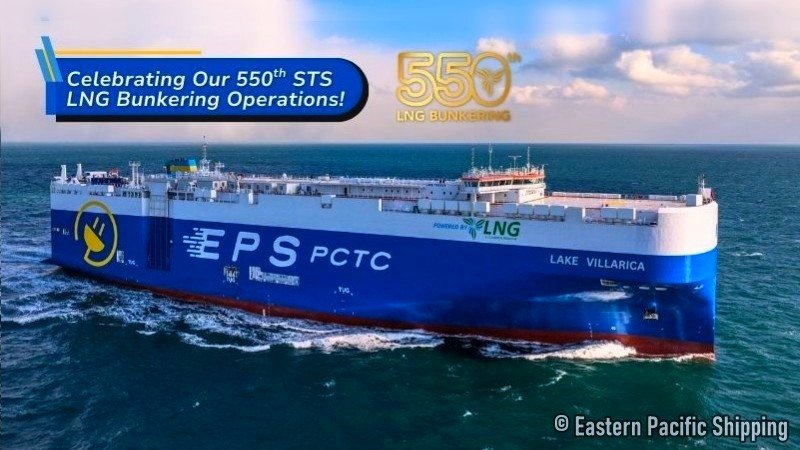
Singapore | January 28, 2026 – Eastern Pacific Shipping Pte. Ltd. (EPS) has reached a landmark achievement in sustainable shipping: the completion of its 550th ship-to-ship LNG bunkering operation. The FueLNG Bellina delivered LNG to EPS’s dual-fuel Pure Car and Truck Carrier (PCTC) Lake Villarica in Singapore, underscoring LNG’s transition from experimental fuel to operational mainstream.
This milestone signals more than numerical progress; it is industrial-scale proof that maritime decarbonization is no longer a future-state aspiration but a present-day operational reality. EPS has demonstrated that the technical, logistical, and regulatory frameworks required for large-scale LNG adoption are now fully viable.
“We extend our sincere thanks to our partners at Shell Marine and FueLNG Private Limited, and to the EPS teams onboard and ashore, whose dedication made the success of our 550th STS LNG bunkering operation possible.” EPS Said.
Table of Contents
Breaking the Infrastructure Barrier
Historically, LNG adoption in shipping was held back by the “chicken-and-egg” problem: ports lacked infrastructure while owners hesitated to invest in dual-fuel vessels. By reaching 550th successful STS bunkering operations, EPS has de-risked the market, showing that deep-sea decarbonization can be executed reliably across multiple vessel types and global ports.
The 550th refueling operation in Singapore was a showcase of coordination and regulatory compliance, involving the EPS-managed Lake Villarica, bunker supplier FueLNG, and partner Shell Marine. This successful execution reaffirms Singapore’s position as the world’s premier LNG bunkering hub.
LNG Adoption Across Diverse Vessel Types
Choosing the PCTC Lake Villarica for this milestone highlights the normalization of LNG beyond tankers and containerships. EPS’s dual-fuel fleet now spans traditionally “hard-to-abate” segments, including Newcastlemax bulkers and Suezmax tankers. By proving LNG’s viability across multiple vessel types, EPS signals a paradigm shift in industrial-scale maritime decarbonization.
A Chronicle of Acceleration: 2021–2025
EPS’s journey from pioneering LNG adoption to operational scale has been rapid. The company’s “hockey-stick” growth in LNG operations has seen nearly half of its cumulative volume completed in 2025 alone.
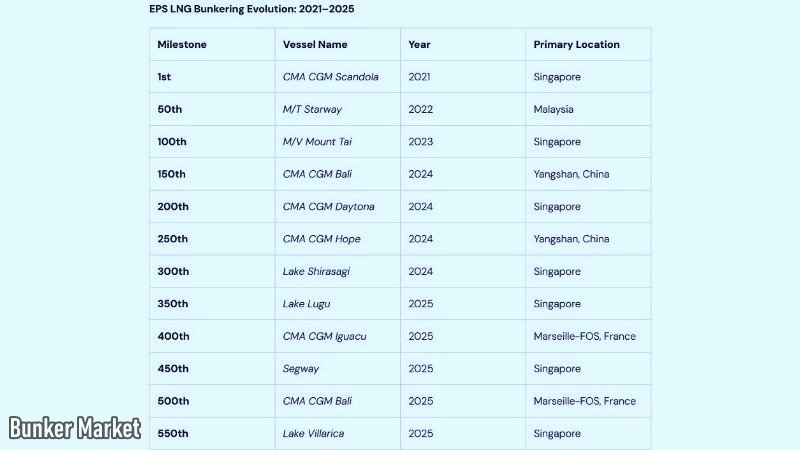
From the first pilot operation to routine industrial processes, EPS has transformed LNG bunkering into a high-frequency, globally replicable standard.
Operational Excellence and Technical Leadership
The primary barrier to LNG adoption is not fuel availability, but operational expertise. EPS has pioneered Simultaneous Operations (SIMOPS), enabling vessels to bunker LNG while cargo is loaded or discharged, reducing port stays and proving that environmental responsibility can coexist with commercial efficiency.
Key technical differentiators include:
- ME-GI engines (M-type, Electronically Controlled Gas Injection) to minimize methane slip.
- Deployment of dual-fuel technology in traditionally conservative segments, proving readiness for spot market operations.
- Bunkering vessels such as FueLNG Bellina and FueLNG Venosa, designed for precision, speed, and safety.
Environmental Impact: Tangible Benefits
EPS’s strategy demonstrates measurable emission reductions:
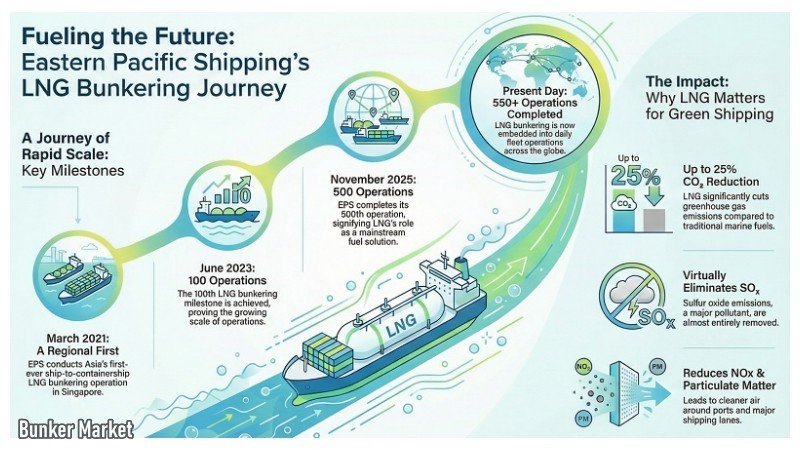
- CO2: 20–25% reduction compared to conventional marine fuels
- SOx: Near-total elimination
- NOx and particulate matter: Dramatic reductions, improving port air quality
Moreover, EPS’s dual-fuel vessels are bio-LNG and synthetic LNG ready, ensuring future-proofing for a transition to zero-carbon fuels like ammonia or hydrogen.
A Global Decarbonization Ecosystem
EPS’s milestone reflects a broader strategic network:
- Singapore
- China (Yangshan, Shanghai)
- France (Marseille-FOS)
- Malaysia
Collaboration with regulators, ports, and fuel suppliers, including MPA Singapore, FueLNG, Pavilion Energy, Shell Marine and TotalEnergies, has created a robust green corridor that supports global LNG-powered trade.
Eastern Pacific Shipping (EPS) – The Roadmap to Net-Zero
With a fleet of 137 dual-fuel vessels across 31 million DWT, managed by 7,000 employees, Eastern Pacific Shipping (EPS) has become a living laboratory for maritime decarbonization. The 550th LNG bunkering milestone proves that the technology, infrastructure, and expertise for low-carbon shipping are operational today, enabling immediate emission reductions while maintaining commercial agility.
EPS’s journey offers a clear message to the global maritime community: the tools for sustainable shipping are here, now, and scalable.
Source: Eastern Pacific Shipping (EPS)